
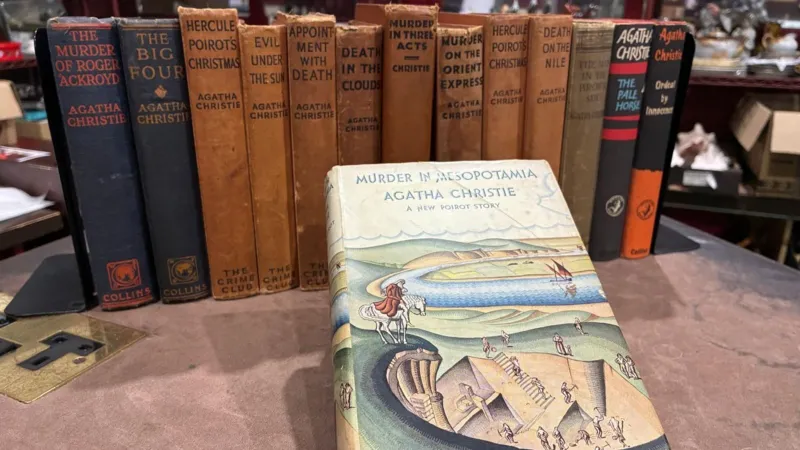
A collection of first-edition Agatha Christie novels that included some signed by the author have sold for £40,000.
The books, which were owned by different people, were sold at a specialist auction run by TW Gaze in Diss, Norfolk, on Friday, and included a copy of Murder in Mesopotamia which sold for £28,000.
Other books in the collection were previously owned by Caroline West, who said her grandparents were lifelong friends of Agatha Christie.
Rob Henshilwood, a book specialist who ran the sale, said the market for rare books was “stronger than ever”.
Christie was born in Torquay in 1890 and worked as a nurse at the town’s Red Cross hospital during World War One.
The author, who died in 1976, wrote more than 80 books and is one of the bestselling novelists of all time.
Henshilwood said the sale of 26 Agatha Christie first editions, five of which were signed by the author, had caused a lot of excitement.
He estimated there were fewer than 1,000 copies of each book in the collection and there were likely to be only “hundreds” with their original dust jackets.
He added he was “amazed” to have the books as it was “rare to have signed pre-war Agatha Christie firsts and they’re very sellable”.
The signed copy of Murder in Mesopotamia, a Hercule Poirot mystery novel by Christie first published on 6 July 1936, is the most expensive single book the auction house has ever sold.
“The market for rare books is probably stronger than ever,” Henshilwood said.
West’s grandfather served in the Royal Army Medical Corps and met Christie shortly after World War One in Mesopotamia.
West never met Christie, but said the books had been gifted to her grandparents by the author.
“Many of them had little inscriptions in them to my grandparents just saying, ‘I hope you enjoy this’ and then signed by Agatha,” she said.
West said she has kept three of the books gifted by Christie as they were “particularly personal to the family”.
“I just thought it would be nice for the others to go out and be shared or owned by somebody else,” she added.
Credit: BBC