
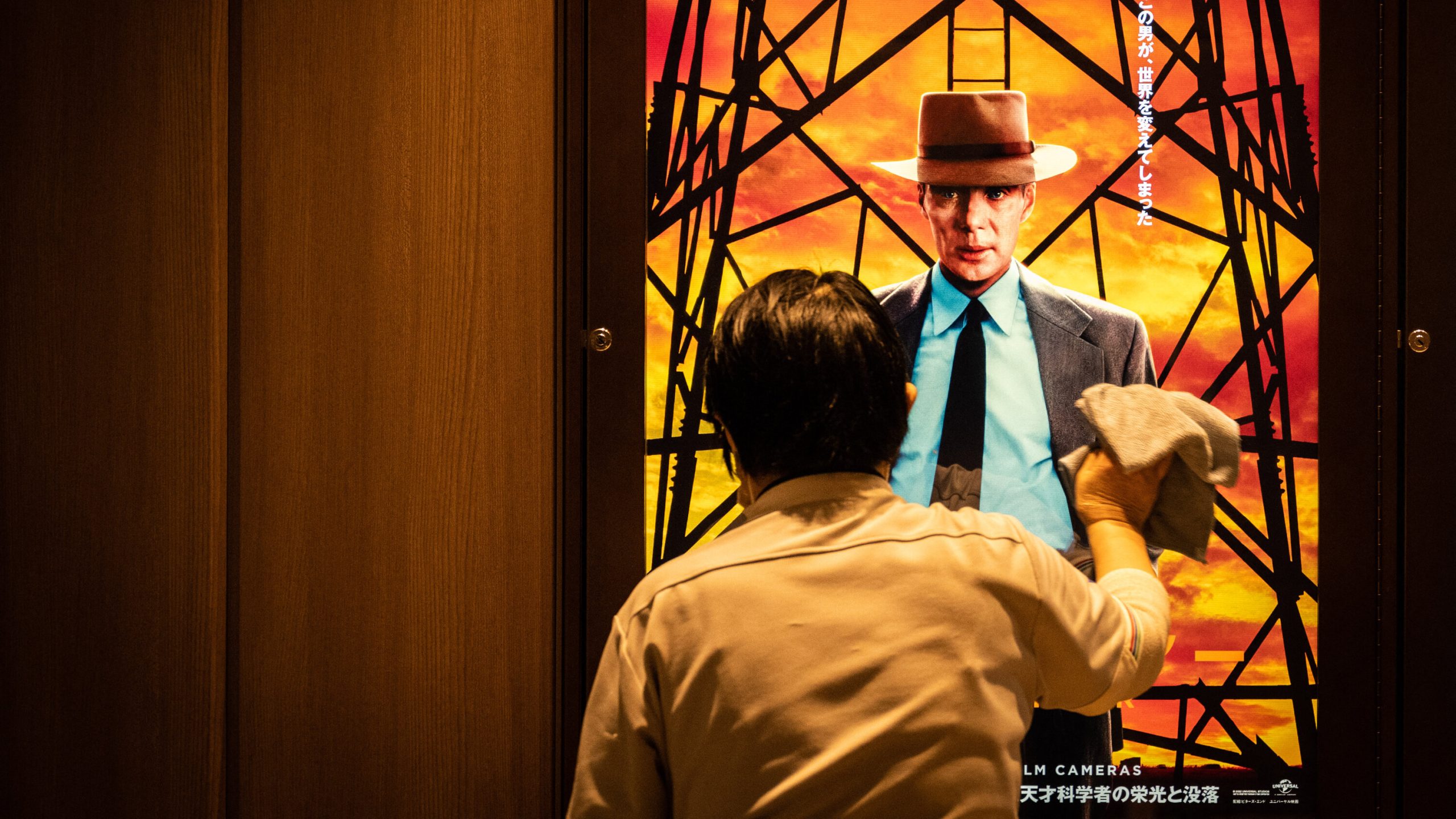
Watching “Oppenheimer,” the Oscar-winning biopic about the father of the atomic bomb that opened in Japan on Friday, Kako Okuno was stunned by a scene in which scientists celebrated the explosion over Hiroshima with thunderous foot stomping and the waving of American flags.
Seeing the jubilant faces “really shocked me,” said Okuno, 22, a nursery-school teacher who grew up in Hiroshima and has worked as a peace and environmental activist.
Eight months after Christopher Nolan’s film became a box office hit in the United States, “Oppenheimer” is now confronting Japanese audiences with the flip-side American perspective on the most scarring events of Japan’s history.
The movie follows the breakthrough discoveries of J. Robert Oppenheimer and his team before the United States struck Japan with the first salvo of the nuclear age. It won seven Academy Awards last month, including for best picture.
Okuno, who watched the film in Tokyo on Saturday, lamented that it did not reflect the experiences of the hundreds of thousands of atomic bomb victims in Hiroshima or Nagasaki.
“It is scary to have this film go out in the world without the proper understanding of the effects of the nuclear bomb,” she said. As for the regret that Oppenheimer expresses in the second half of the film, “if he really thought he had created technology to destroy the world,” she said, “I wish he had done something more about it.”
Bitters End, the indie Japanese distributor that released the film, said in a statement in December that it had decided to put “Oppenheimer” in theaters after “much discussion and consideration,” because the “subject matter it deals with is of great importance and special significance to us Japanese.”
Long before the movie opened in Japan, prospective viewers were angered by American fans who seemed to make light of the atomic bombing with fused images from “Oppenheimer” and the film “Barbie” in an online “Barbenheimer” meme.
Mindful of domestic sensitivities, some theaters in Japan are carrying trigger warnings, with signs cautioning audiences about scenes “that may remind viewers of the damage caused by the atomic bombings.”
The film, which opened at 343 theaters nationwide, grossed 379.3 million yen ($2.5 million) in its first three days, making it the country’s highest-grossing foreign film so far in 2024.
Some commentators said they appreciated that the film was being shown in Japan despite the earlier controversy. “We must not create a society that makes it impossible to watch, think and discuss,” wrote Yasuko Onda, an editorial board member at The Yomiuri Shimbun, Japan’s largest daily newspaper. “We must not narrow the eyes that see films.”
While some people, including atomic bomb survivors, have protested the exclusion of scenes from Hiroshima or Nagasaki, Yujin Yaguchi, a professor of American studies at the University of Tokyo, said that “Oppenheimer” simply reflects a conventional viewpoint that omits many others from the narrative, including the Native Americans whose land was used for nuclear testing.
The movie “celebrates a tiny group of white male scientists who really enjoyed their privilege and their love of political power,” Yaguchi wrote in an email. “We should focus more on why such a rather one-sided story of white men continues to attract such attention and adulation in the U.S. and what it says about the current politics and the larger politics of memory in the U.S. (and elsewhere).”
Some viewers who saw the movie over the weekend said they recognized that the film had another story to tell.
Tae Tanno, 50, who watched it with her husband in Yokohama, Japan’s second-largest city, said she focused on Oppenheimer’s revulsion as he began to grasp the devastating damage that he and his fellow scientists had unleashed.
“I really thought that, oh, he did feel this way — a sense of remorse,” Tanno said.
That depiction of a moral conscience may reflect changes in American public sentiment, said Kazuhiro Maeshima, a professor of American government and politics at Sophia University in Tokyo.
A few decades ago, a film portraying the guilt felt by the bomb’s creator might have been unpopular in the United States, where the received narrative was that the atomic bombs had averted a costly invasion of mainland Japan and saved the lives of thousands of U.S. soldiers, Maeshima said.
In 1995, for instance, the Smithsonian Institution in Washington drastically cut back an exhibit displaying part of the fuselage of the Enola Gay, the B-29 bomber that dropped the atomic bomb on Hiroshima. Veterans groups and some members of Congress objected to portions of the proposed material that raised doubts about the U.S. rationale for dropping the bomb.
“Thirty years ago, people thought that it was good that the bomb was dropped,” Maeshima said. “Now, I feel like there is a more ambivalent view.”
In Japan, viewers may now be more willing to watch a movie that does not focus on the victims, nearly eight decades after the end of World War II and eight years after Barack Obama became the first sitting U.S. president to visit Hiroshima.
Kana Miyoshi, 30, a native of Hiroshima whose grandmother was 7 years old when the bomb fell and lost her father and a brother in the attack, saw the film with her parents in Hiroshima on Saturday.
Like other viewers, Miyoshi was struck by the scenes of celebration after the dropping of the bomb, but she said they should not be condemned. “This is reality, and we cannot change it,” said Miyoshi, whose grandmother died almost three years ago at 83.
Many Japanese support nuclear disarmament, and the country, which has no atomic weapons of its own, relies on the so-called nuclear umbrella of the United States for protection. As North Korea strengthens its nuclear arsenal and Russia threatens to use tactical nuclear weapons in Ukraine, experts said “Oppenheimer” could stimulate discussion about nuclear deterrence as the United States approaches an election that may sharply change its commitment to global alliances.
“There’s so much to confront here in Japan’s position vis-a-vis nuclear weapons,” said Jennifer Lind, an associate professor of government at Dartmouth College who specializes in East Asian security. “This movie is coming at such a fascinating time for them to think about ‘What is our national policy?’”
Japanese peace activists also see fodder for discussion in “Oppenheimer.”
“It’s a great opportunity to think about nuclear weapons from a very international perspective, because normally in Japan, the nuclear weapons issue is taught as a story about Hiroshima and Nagasaki,” said Akira Kawasaki, who serves on the executive committee of Peace Boat, a Japanese nonprofit group that operates cruises oriented around social causes.
As scientists develop artificial intelligence and other potentially destructive technologies that could be misused by governments, Kawasaki said that “Oppenheimer” offered a potential warning.
“Scientists are very vulnerable and very weak in front of all that power,” Kawasaki said. “An individual cannot be strong enough to stand up against those things.”