
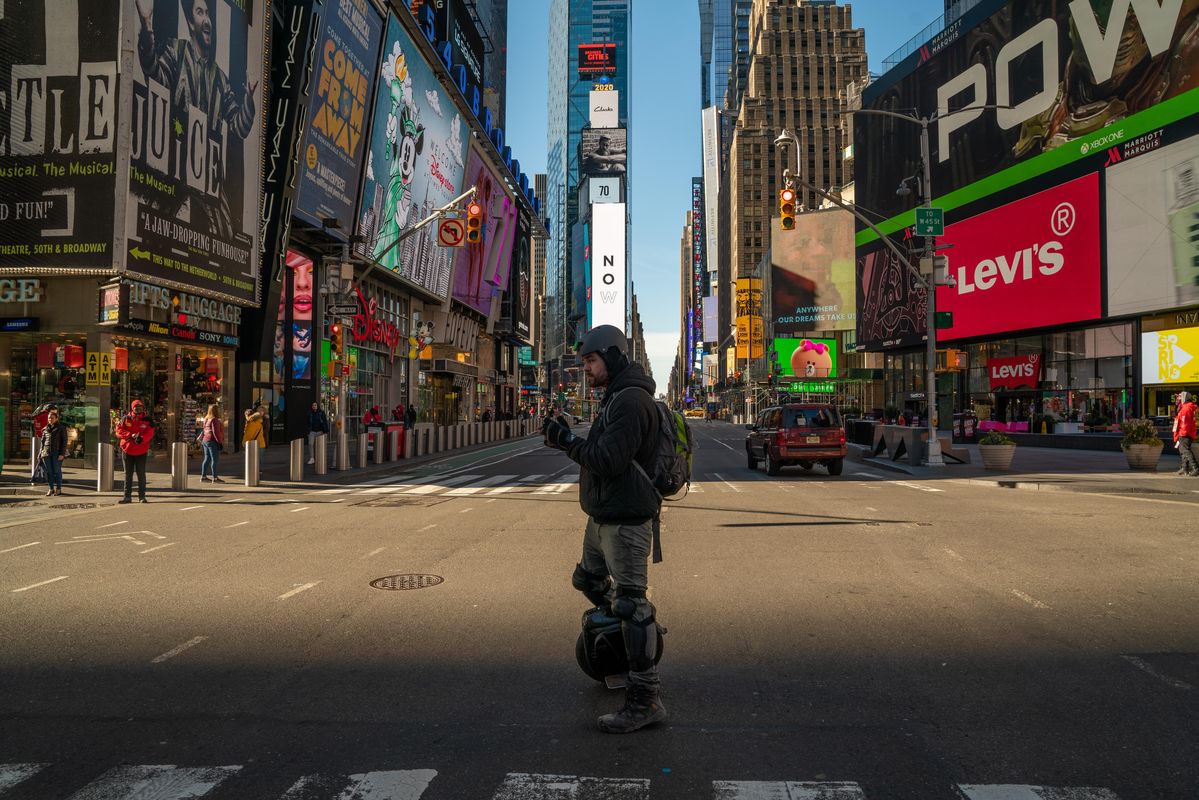
Citing an absence of federal action, the governors of New York, New Jersey and Connecticut took matters into their own hands Monday and announced uniform tri-state rules to shrink crowd sizes and close a number of non-essential businesses. Gov. Phil Murphy also joined the other states in shuttering schools.
There will be no crowds with gatherings over 50 anywhere. Casinos will close Monday night regionwide, as well as movie theaters and gyms. Bars and restaurants will be limited to take-out and delivery only as of 8 p.m. Monday. The temporary closures will remain in effect for as long as necessary to protect public health. Grocery stores will stay open.


It was unprecedented coordination among states to help slow the pandemic that, across the tri-state area, has infected more than 1,000 people and killed nine. As of Monday, New York had 950 total cases, 463 in New York City. New Jersey announced another 80 or so cases later in the day, bringing its total to 178.


“This is not a war that can be won alone, which is why New York is partnering with our neighboring states to implement a uniform standard that not only keeps our people safe but also prevents ‘state shopping’ where residents of one state travel to another and vice versa,” Cuomo said on a joint conference call with the two other governors. “I have called on the federal government to implement nationwide protocols but in their absence we are taking this on ourselves.”
“We want everybody to be home, not out,” Murphy added — and the only way to ensure that is to have a standard set of topline directives and restrictions.
All three governors blasted the federal government for “falling asleep” at the wheel, lacking testing preparation, failing to provide urgent and specific guidance at the national level and not bringing in the military to streamline and facilitate efforts. They said the absence of strong U.S. leadership on these key matters has left them with no choice but to try to do it themselves.
“We’ve got to work on this together,” said Lamont, whose state reported 26 COVID-19 cases as of Monday afternoon. “The feds have been asleep on the draw. If we do this on a regional basis we’re gonna get through it.”
Murphy said on the call that all non-essential businesses must close at 8 p.m. nightly; non-essential travel is “strongly discouraged” between 8 p.m. and 5 a.m. He encouraged New Jerseyans to stay at home during those hours; that’s a suggestion, he clarified Monday, not a state-mandated curfew. He closed all New Jersey schools effective Wednesday (click here for details) and said he would mobilize the National Guard to help in any way needed as New York has.
“This isn’t fake news. This is real,” Murphy said. “You may be asymptomatic and carrying coronavirus … You feel really good and you’re really healthy, and then the next day you’re going to see grandma or grandpa … and you unwittingly are putting their lives at risk. We have got to put an end to business as usual.”
At this point, there is no plan to shut down mass transit in its entirety, but Murphy said they’re working to “right-size” capacity to match reduced ridership. Ridership has plunged across the board amid new directives and the urgent, consistent call for social distancing.
There is also no immediate plan to shut down tri-state roads, but the emergency declarations in New York and New Jersey give the states the power to do so if needed.
New York City in Crisis
How long will it take to emerge on the other side of the pandemic? At this point, it’s difficult to tell — but it will take months, most say.
Earlier Monday, Mayor Bill de Blasio warned the coronavirus crisis — the economic, social and other fallout — may ultimately compare to the United States climate during the Great Depression. He called for direct federal aid to replace lost income as anxious New Yorkers navigate their new reality.
“There has to be direct federal support to put money in people’s pockets and replace the income they’ve lost. That is the only way we’re going to get through this,” the mayor said Monday on Fox.
More on Coronavirus
The local economic impact even at this early stage is already incalculable. Broadway is dark; concert and sporting venues are closed. Restaurants and bars have been shuttered except for take-out and delivery services by executive order across New York, New Jersey and Connecticut.
Cuomo ordered all New York businesses to operate with at least 50 percent of their employees working from home. Non-essential employees are all asked to work from home.
City officials hope the measures will be enough to essentially effect a self-quarantine, drastically reducing the possibility of exposure to the virus by reducing density of population.
The Debate Over Schools – What’s Next?
More than a million New York City public school children are staying home Monday — and for the foreseeable future — after de Blasio heeded mounting, urgent calls to take the unprecedented shutdown action in an effort to curb the spread of coronavirus.
Describing his decision as an incredibly “painful” one, one he could never have imagined he’d need to make, the mayor said he would try to reopen schools April 20 at the earliest, but the reality is they may not be able to salvage the school year. Worst case scenario: New York City public schools, the largest district in the nation, may stay closed for the 2019-20 calendar.
De Blasio seemed to be doubling down on that potential worst-case scenario, saying on MSNBC Monday, “I fear that this crisis is going to start to crescendo through April, May before it starts to get better.”
The mayor held out for at least a week as other cities and states across the country announced sweeping public school closures for two primary reasons: 1) Essential city and other workers, like the FDNY, NYPD and hospital staff, need childcare so they can go to work; and 2) So many NYC students depend on meals they get at school just to eat.
To help address those issues, de Blasio said some schools will remain open to provide grab-and-go breakfast and lunch for kids in need — and certain schools in each borough will convert to learning centers to provide some care for kids whose parents are on the front lines of the city’s new war.
The school system, officials said, would attempt to quickly launch a “remote learning” program a week from Monday, with teachers being trained on the methods beginning Tuesday. Cuomo asked for more complete plans from the city to provide childcare for essential workers and meals for kids by midnight — and noted those plans must be approved by his office.
Cuomo has ordered the closure of the rest of the state’s schools effective March 18; that closure will last at least two weeks. Some counties, including Nassau and Suffolk, had previously announced plans to close their districts.
Coronavirus Latest
Nationally, about three dozen states have initiated similar actions. New Jersey schools — public, private and parochial — joined the ranks and were set to close Wednesday for at least two weeks, most likely longer, Murphy said.
Source: www.nbcnewyork.com