
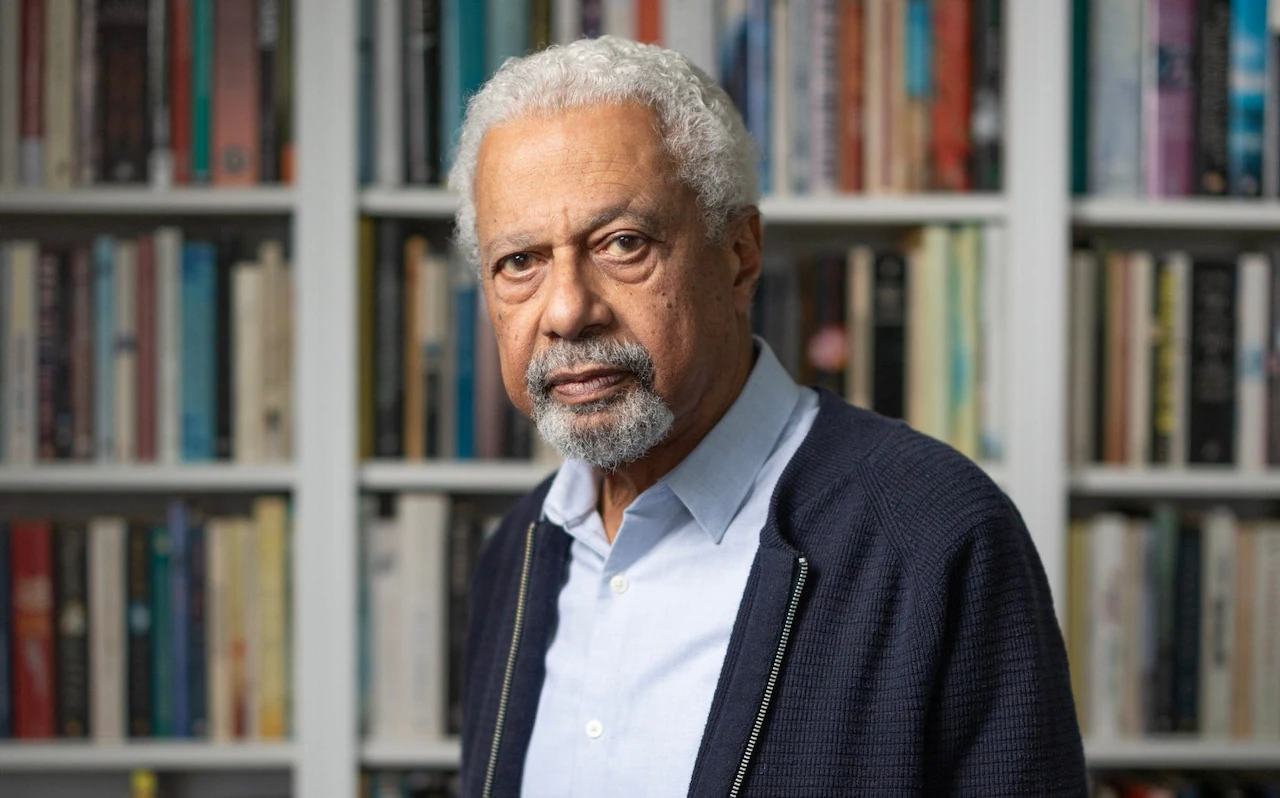
Abdulrazak Gurnah surveys his garden – and sighs. “I used to grow vegetables,” he says, “but with so much travelling it’s not possible to do it properly.” Gardening, it seems, has to go by the wayside when you win the Nobel prize in Literature. So does literature.
No sooner had Gurnah, now 76, been announced as the 118th laureate in October 2021 than he was launched on a ceaseless round of globe-trotting, speechifying and meeting-and-greeting. Eventually, he ordered his agent to accept no new engagements for six months and finally finished his latest novel, Theft – the book he had been working on when the Swedish Academy rang him with the good news.


Softly spoken but forthright, the white-bearded Gurnah, who was chair of English and Postcolonial Literatures at the University of Kent until his retirement in 2017, retains the bearing of an emeritus professor – congratulating me on an insightful question, smiling indulgently at those he judges more banal. We are talking in the new home that he and his wife, the Guyanese-born academic Denise deCaires Narain, moved into a few months ago.


With the £840,000 Nobel bounty, the couple, who have four children and 10 grandchildren, opted for an unostentatiously attractive house in a tiny village in Kent. Gurnah has lived in the county more or less ever since he arrived in Canterbury in 1968 as a 19-year-old refugee from Zanzibar (now part of Tanzania).
He insists I mustn’t leave the area without walking the few minutes to Oswalds, the house where Joseph Conrad lived and died. “He was born speaking Polish, of course, but chose to write in English. Why? Because you can find an intimacy with a language that isn’t the one you speak most fluently. I speak and write Swahili, but I don’t think I can evoke what I can in English in the same way.”
Gurnah’s novels are written in an unshowy, elegant, often pleasingly old-fashioned prose that lends a certain beauty to stories that are sad and sometimes squalid. Several are about the experiences of African immigrants in Britain (Pilgrims Way, By the Sea, Gravel Heart); others are historical novels set in colonial East Africa (Afterlives, Desertion, the Booker-shortlisted Paradise).
Theft, his 11th novel, spans half a century and marks Gurnah’s first attempt to write extensively about Tanzania after the Revolution of the 1960s. One of the central figures is Badar, a teenager who works as a servant for his wealthier relatives, until he is falsely accused of stealing groceries and sacked.
“That happened to somebody I knew when I was young, about the same age as me, who was a servant – servants in Zanzibar meaning pretty raggedy guys who did errands,” says Gurnah. “This injustice has stuck with me all these decades. He was powerless, and I often write about the powerless: how they learn to cope and survive, and with some integrity as well.”
The book also focuses on Badar’s well-off cousin Karim, who, as the country becomes less hidebound and forges closer ties with Europe, seizes new opportunities both financial and sexual, while neglecting his long-suffering wife. “I’ve seen this in Tanzania and in many places in Africa: as these new possibilities open up, people do talk themselves out of a sense of what is the right thing to do, and do things that are really unkind or actually crooked.”
Although Gurnah makes frequent trips to Tanzania, he would not return to live there. “I’ve made my life here. And the same problems remain. Some of the prosperity is driven by tourism, which has its downside: building bigger and bigger hotels is a priority, building better schools or paying teachers properly are not.”
Wasting money is nothing new in Zanzibar. He recalls glimpsing Princess Margaret on a visit to the country in 1956: “They built a special pier just for her to step out on to, which was never used again except by young people diving into the sea.”
Abdulrazak Gurnah has published ten novels and a number of short stories. The theme of the refugee’s disruption runs throughout his work. He began writing as a 21-year-old in English exile, and although Swahili was his first language, English became his literary tool.#NobelPrize— The Nobel Prize (@NobelPrize) October 7, 2021
He remembers, too, the extraordinary sight of British soldiers: “We regularly used to have some [Royal] Navy ships coming in, I guess just to show us who’s the boss, and some regiment or other would march through the town. I was astonished because I thought they all had great big hairy heads – I didn’t know about busbies.
“We didn’t think the British were evil. They were just irrelevant to be honest, we just wanted them to go.”
Independence in 1963 was swiftly followed by the Revolution, with the majority Black African population overthrowing the Sultan of Zanzibar’s Arab government, and thousands of people slaughtered or imprisoned. “This is what happens with empires. Everything is stable and orderly because there is coercion – remove that coercion too quickly and there is chaos, everything that has been tamped down erupts. This is what’s happening in Syria at the moment.”
Gurnah and his brother left Zanzibar illegally, arrived in England on tourist visas and fetched up in Kent where a cousin was studying. It was the year of Enoch Powell’s “Rivers of Blood” speech, and Gurnah felt far from welcome: “It was not about sometimes being abused or being called names, but a constant sense – the way people stop talking when you go into a shop – of ‘You’re not welcome here, we don’t want you’. Every now and then this still happens but, when you’re used to it, you don’t care any more.”

Miserable, lonely and poor, Gurnah worked as a hospital cleaner for some years. He had no ambitions of becoming an author, but began to put his experiences into writing, “because it helps to disentangle things when you’re feeling gloomy. And then you start to organise what you’ve written – and you’re hooked.” While taking a PhD on African literature at the University of Kent, he wrote his first novel Memory of Departure (1987).
His 2001 novel By the Sea featured a British immigration official who was notably cruel to migrants, despite himself being of Romanian heritage: a character whose background was inspired by that of the Conservative Home Secretary Michael Howard. “[Howard] was vocal about foreigners, and I thought, what ironies: here’s this man – and there was [Michael] Portillo as well – whose parents were recent migrants. It was a very similar phenomenon with Sunak and Priti Patel, these people whose parents were themselves migrants who are now the most virulent haters of migrants.”
What accounts for it? “I think it’s racism. I think people of Indian ancestry in Africa, which both Sunak and Priti Patel are descended from, were on the side of the British against the Africans. They see people of either Arab or African ancestry as inferior people, that’s my guess.”
He is pleased that in the UK “people are talking about slavery now, and the idea of reparations has become something which is not quite lunatic to talk about, or the returning of various stolen artefacts. There is some movement, as other countries are doing, to listen to the concerns of people saying: ‘We are still living through the consequences of things that you did’ – inequalities, financial burdens. But,” he says, politely impatient at being nudged into the role of pundit, “we are wandering a long way from books.”

I ask what difference the Nobel Prize has made to the career of a writer who, unlike the other 20th-century British Laureates – Harold Pinter, Doris Lessing, Kazuo Ishiguro – was not already a household name when he got the call.
“A fantastic difference. Suddenly all my books were back in print, translations all over the place. I’ve been translated into Swahili for the first time. And I get to meet hundreds of these new readers. I’ve just come back from a wonderful month travelling in Latin America [with] so many people saying to me: ‘Your experiences, we go through them as well – the leftovers of the experience of colonialism.’ It is a kind of solidarity of shared history.”
Gurnah became a British citizen decades ago, giving up his right to be a Tanzanian national as his homeland does not allow dual citizenship. Nevertheless, after his Nobel triumph he “got an email from the president of Tanzania, and when I first went to Zanzibar after the Nobel there were dancers and bands and a motorcade, sirens howling through the streets”. The British government never sent the new Laureate a word of congratulation, however. “I don’t know why, but for sure they weren’t bothered.”
For now, it’s back to his next book. Does the weight of the Nobel make writing easier or harder? “The process of actually formulating what I want to say isn’t any easier – the computer doesn’t seem to realise that a Nobel winner is talking to it. But it’s not intimidating either. They gave this award to me for what I’ve been doing; why should I do anything different?”
Credit: Telegraph