
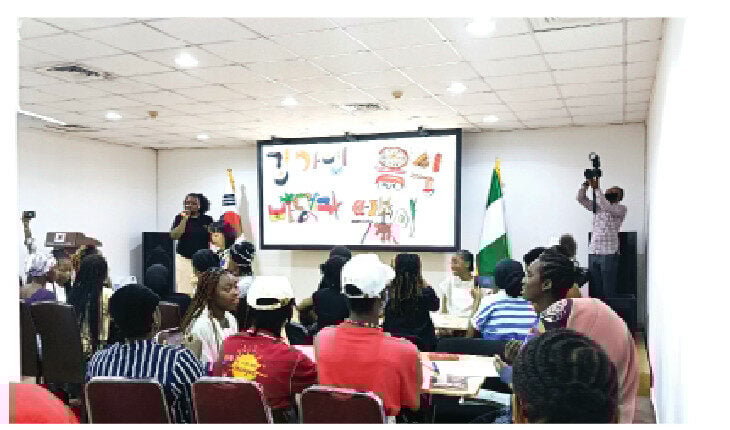
To mark the 582nd year of the Hangul (Korean alphabet) creation, Korea Culture Centre Nigeria (KCCN) took Nigerians on a fun and artistic exploration of the letters.
Unlike Calligraphic Art, which focuses on the aesthetic and cursive representation of words or letters on paper, the participants were encouraged to come up with any Korean word of their choice and use images of objects reminiscent of the Hangeul characters to represent the word on paper.
The exercise seemed too simple to deliver in 40 minutes. By the time the participants, who were predominantly Korean language students at the centre, could decide on a Korean word, figure out what objects visually represent the Hangul letters, and then apply the graphic aesthetic and colours necessary, 40 minutes seemed too short.
However, the sense of accomplishment that comes from conceptual thinking, the visual representation of their thoughts and the all-round camaraderie and adrenaline that comes with creating art made the exercise worthwhile. At the same time, it showed Hangul’s possibilities and flexibility.
Founded in 1443 by King Sejong of the Joseon Dynasty, the Korean alphabet was created to allow all Koreans to express themselves easily.
Before the creation of the alphabet, Korea, which was greatly influenced by the Chinese culture and religion (Confucianism), practised the ‘Hanja’ writing system. ‘Hanja’, which is the use of Chinese characters to write the Korean language, was very difficult to learn. Thus, King Sejong came up with Hangul, alphabets that sound the way they are pronounced.
Initially, Joseon nobles who had spent years studying the ‘Hanja’ were rejected Hangul, but in time, the King’s devotion to the improvement of the life of the Korean people and the citizens efforts, in particular social groups and women, in promoting the alphabet, solidified its use. In 1446, three years after its creation, it was proclaimed the official alphabet of Korea.
Today, Hangul consists of 24 letters, 14 consonants, and 10 vowel sounds. It is marked annually by Koreans on October 9.
On the importance of Hangul in the promotion of Korean culture, Korean language student, Christine said, “You can’t speak Korean language without knowing the characters and how to string them into words or sentences. In class, we are taught to represent Hangul via human figures, shapes or diagrams in our daily lives. This way, one can connect Hangul to every other thing.”
However, the celebration of Hangul raises an interesting question of how and when the Nigerian local languages came into existence. A question that is unknown to many Nigerians.
“As a Christian, I believe our languages came to be when God dispersed the people from continuing the construction of the Tower of Babel by giving them different languages,” joked Christine. Her response, though, is in reference to how old and untraceable the history of Nigerian languages is.
She however added that contrary to Korea, a mono-language society, that had to intentionally craft and sustain their language to avoid its extinction owing to colonization, Nigeria is a multi-language society.
“I have never wondered about that, because I think that while we may speak different languages, we are still one. We have kinship with one another, and we have been through a lot together that unites us as a people irrespective of our languages.”
Conversely, Hangul student and corps member, Esiri, said the loss of knowledge of Nigerian languages history may stem from the fact that they were more orally centered than written, to say nothing that not many Nigerians are versed in writing them.
“Maybe we won’t know the day our languages originated. The Korean alphabet was made because King Sejong said, “We will have to write our language”. It would be nice to have a day to celebrate our languages, and say, “this is the day of learning Hausa, Yoruba and Igbo.”
For KCCN Hansik Class coordinator, Sharon Pwavi, the activities around the formation and spread of Hangul is indicative of the intentionality that went into its creation. “The center celebrates this event as a way to help people understand Korean language, Hangul and its history; to appreciate its artistic and calligraphic qualities, and to promote Korean language.”