
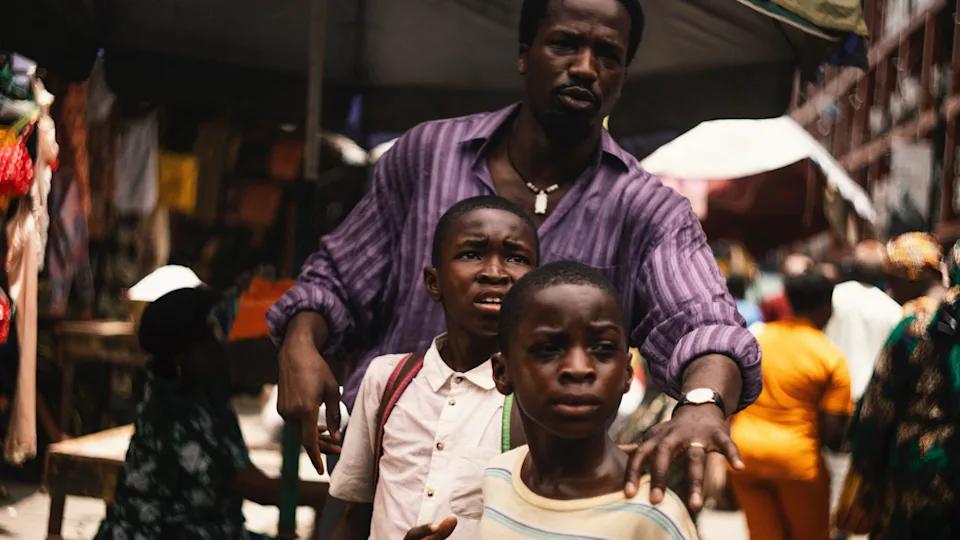
Akinola Davies Jr. remembers the Lagos of his childhood as one brimming with cultural abundance in the same breath that it is being tamped down. Urban life, with all its bustle, business dealings, friendly spars and the smell of wara cheese is met with the force of government crackdowns, corruption, and fear. My Father’s Shadow, the filmmaker’s beautiful, loosely autobiographical feature debut, which premiered at the 2025 Cannes Film Festival, reignites that confusion and the sandstorm of mixed emotions in the context of the Presidential coup of 1993.
For brothers Akinola and Olaremi (real-life siblings Godwin Egbo and Chibuike Marvellous Egbo, respectively), that world is doubly bewildering, as their introduction to the city’s native wildness comes thanks to the sudden reappearance of their father, Folarin (Ṣọpẹ Dìrísù). The eight and eleven-year-old boys are playing on their front porch, way outside city life, the scarcity of their lives apparent through split portions of porridge and decaying door frames, when a sudden gust of wind leads them to Fola, who is nonchalantly getting dressed and searching for his watch. Is he a ghost?
Not really, but everyone in the city seems to greet him as such, so long has his absence been. Olaremi is thrilled to be by his father’s side, while Akinola is a bit skeptical. He has a hard time understanding how someone who claims to love their kids can spend so much time away, and no protestation that work and money demands time will make him understand. “Mom says God loves me very much… does that mean that people who love us don’t see us very much?”
My Father’s Shadow Frames the Domino Effect of Political Corruption Into the Domestic Space.
Much of My Father’s Shadow is filmed in patchwork, with Davies Jr. sprinkling into scenes shots of the street, of bugs, of body parts, of food, all of which comes at us in the same way a child may be distracted by sensory overload in the midst of a conversation. For the kids, this new time with their absent father is a cosmic gift, but it’s a lot of information at once. And it isn’t as if their father is all together equipped to explain the complexities of political corruption to children with whom he is always having to reestablish a connection.
Softly, the film focuses on Fola’s attempt to get the money that he’s owed at his job, but when they show up, his boss is nowhere to be found. Davies Jr. consistently keeps us locked in the POV of his two extraordinary child actors, a choice which keeps us at arm’s length from understanding the depth of Fola’s needs and the details of his time away. But the narrative, such as it is, is really a portrait of fast-forwarded adulthood, with both kids being thrust into understanding matters as complex as adultery, political coups and financial solvency.
Much of the political aspect is kept on the margins, with Davies Jr. allowing us only glimpses of newspaper headlines and snippets of radio debates. Even their father’s political feelings are abstracted. For the kids, of course, what’s more important to them is the extended time with a parent they rarely see, relishing getting food together and swimming in the sea. But the atmosphere is palpable with tension as the people wait to hear if the current regime will accept the victory of the populist MKO.
Eschewing the normal route of fatherly estrangement, Davies Jr. instead paints a more difficult portrait of his would-be father as someone whose desperation for financial independence has kneecapped his intention of being a devoted parent. A deceptively complex film which marries the tentative hopes and fears of a country on the brink of a new age with the dynamic of a family caught in the web of financial scarcity, My Father’s Shadow captures a rare feeling of heartache, and of love.
My Father’s Shadow opens in select theaters on February 13th, 2026.
Credit: screenrant.com