

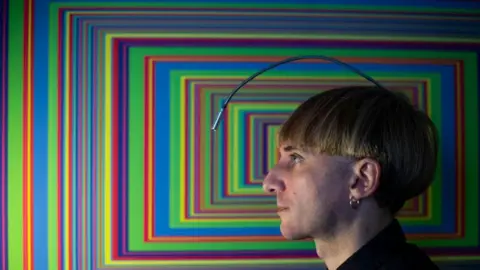
or the past 20 years, self-declared “cyborg artist” Neil Harbisson has provoked debate with his “eyeborg” – a surgically attached antenna.
Harbisson, who grew up in Barcelona, is colour blind, having been born with the rare condition achromatopsia, which affects one in 33,000 people.


This means he sees in what he calls “greyscale” – only black, white and shades of grey.

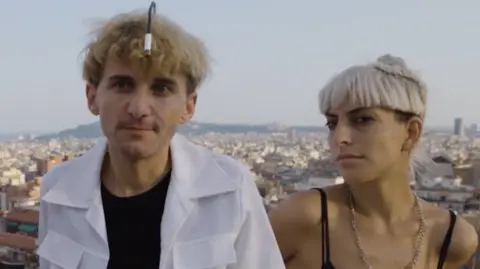
But he decided to have surgery in 2004 which changed his life – and his senses – attaching an antennae to the back of his head, which transforms light waves into sounds.
When film director Carey Born came across Harbisson, classed by Guinness World Records as “the first officially recognised ‘cyborg’,” she was “gobsmacked and astonished”.
Her next move was to meet him, and then make a film about him – Cyborg: A Documentary.
It explores how he navigates his life, along with effects and implications of his unusual surgical procedure.
“The reason he did it was not to substitute the sense that he was lacking – it was in order to create an enhancement,” Born tells the BBC.
“So that was really the main hook that I thought was fascinating.”
As a student, Harbisson had met Plymouth University cybernetics expert Adam Montandon, who enabled him to “hear” colour using headphones, a webcam and laptop – transforming light waves into sounds.
Harbisson seized on this experience, but wanted more, by merging the technology with his own body – something Spain’s bioethical committees repeatedly rejected.
He eventually persuaded anonymous doctors to operate, removing part of the back of his skull so the antennae could be implanted and the bone could then grow over it.
Harbisson, who describes himself as a “cyborg artist”, has said: “I don’t feel like I’m using technology, I feel like I am technology.”
The term cyborg refers to a being with human and machine elements, giving them enhanced abilities.
Cyborgs are already a feature of popular culture and sci-fi, appearing in TV series like Doctor Who, The Six Million Dollar Man and The Bionic Woman, and films including Terminator and Robocop.
The chip in the back of Harbisson’s head allows him to hear the colours not through his ears, but through the bone of his skull. It also connects to nearby devices as well as the internet.
His partner, Moon Ribas, says in the film: “He is brave, he likes to do things differently”, while he says his antennae “allows me to extend my perception of reality”.
Harbisson explains in the film that post-surgery, he had five weeks of headaches, and it took him about five months to get used to the antennae.
Born says after the procedure he got “depression, because like when they did trepanning [a surgical intervention where a hole is drilled into the skull] in the 60s and 70s.
“People got really big side effects – he had that as well.”
She admits she was unsure what to expect when they first met, but found “Neil and Moon were very personable… I thought they would make an accessible way into the subject”.
The film shows how people respond to him, asking about his appearance, and we see him producing artworks based on his perception of colour.
This article contains content provided by Instagram. We ask for your permission before anything is loaded, as they may be using cookies and other technologies. You may want to read
before accepting. To view this content choose ‘accept and continue’.Accept and continue
But life post-antennae has not been straightforward – the film also reveals he’s received death threats, from people who object to how he has modified his body.
Harbisson touches on this in the film.
“For many years we’ve had different types of death threats, from people who really hate what we’re doing, because they think it’s anti-natural or anti-God,” he says.
“So they think we should be stopped.”
The threats caused the couple to relocate their home to somewhere new, its precise location a closely guarded detail.
Born says: “It’s such a shame… they’re very gentle people”.
But she adds that her film injects possible notes of caution into the issue of body augmentation.
Harbisson’s credo, which includes his own business interests, is: “Design Yourself.”
But Born wants to get people thinking about “security – and the hacking potential all of these things could result in”.
“There’s a safety issue in terms of who is doing it, what are the circumstances that they’re doing it under, and what are the possible outcomes or consequences?” she adds.
A 2022 survey by US think tank the Pew Research Centre, into AI and human enhancement, suggests the US public may have some reservations.
Those surveyed were “generally more excited than concerned about the idea of several potential changes to human abilities”.
But many were “hesitant or undecided” about the virtues of biomedical interventions to “change cognitive abilities or the course of human health”.
The film also highlights that three years earlier, BBC News presenter Stephen Sackur highlighted possible ethical concerns about body augmentation.
He challenged Harbisson during an interview at Swiss debating conference, the St Gallen Symposium.
“There are all sorts of ways in which this is worrying and alarming… not least because you call yourself transpecies, but you’re acquiring abilities that are beyond the capacity of other human beings,” he said.
He also queried enhancements “only available to those who have the means to undertake this sort of thing, creating possibly an uber-species”.
But Harbisson said his not-for-profit Cyborg Foundation tries to make such augmentations “as available as possible”.
“It’s not expensive to create a new sense, but we are giving all these senses to machines,” he said, such as cars or hand dryers.
“You can just add them to your body – it’s just people who wish to extend their perception.”
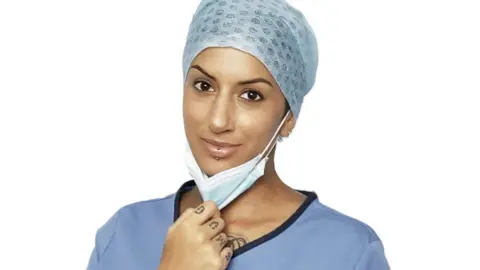
Body modification artist Jenova Rain worked with Harbisson in 2018 during Manchester Science Festival, and sees his work as “amazing and very important”.
“He’s pushing the boundaries of what we’re trying to achieve as a species,” she tells the BBC.
“I think we need more people to be as brave and bold as he is.”
Her job also includes combining technology and the human body – she implants microchips into people’s hands, carrying out about 100 per year.
The microchip would open a door, for example, much like an electronic key for a car.
“Primarily we were looking at doing this as access for people with disabilities, or mobility and dexterity issues, who struggle using keys specifically,” she tells the BBC.
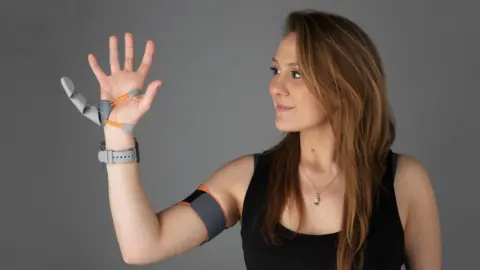
Dani Clode, an augmentation designer for Cambridge University’s neuroscience plasticity lab, finds Harbisson “fascinating” but says she and her colleagues are still working out if augmentation is “a good thing, or is it a bad thing?”
“I’m choosing my words carefully here because it is an exciting and interesting area. We just want to make sure it’s done safely,” she tells the BBC.
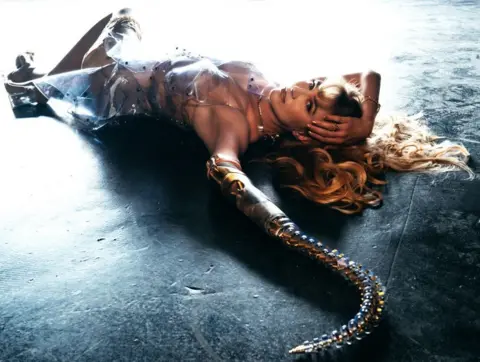
Her work includes creating a removable extra thumb and a tentacle arm.
Clode demonstrates the thumb, operated by a pressure pad under the wearer’s big toe.
“I make the devices, and the lab uses them to understand the future brain,” she explains, adding they study the impact on the brain when the body is augmented.
“After five days of training with this device [we learned] we could alter the brain,” she says.
“We fundamentally changed how they used their hand for that for that week, which then showed up in their brain.”
Born adds a final note of caution.
“Cybernetics will happen – it is happening,” she says.
“I think often the politicians and the regulatory bodies or those parts of government are very slow, and that technology is not allowing for that.
“The technology is accelerating so fast, but we plod along.”
She’s concerned about who ends up holding the keys to cybernetic technology.
“If it’s all in the hands of a particular few individuals, or a few very elite, very rich influential organisations, that is not a democratic process, and it’s going to affect all of us.
“So I’m just alerting people, in a nice, accessible way.”
Cyborg: A Documentary is in UK cinemas on 20 September.