
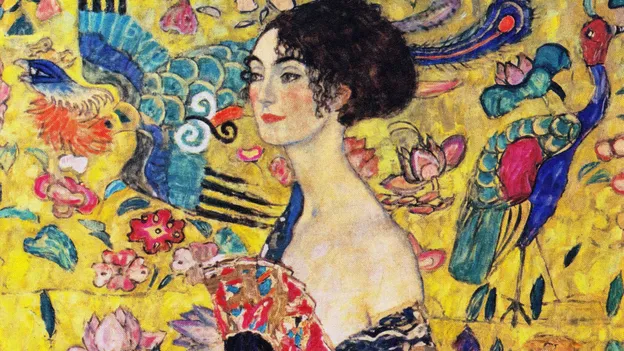
Left on Gustav Klimt’s easel when the artist died in 1918, Lady with a Fan is the most expensive painting auctioned in Europe, selling for £85.3m – but what makes it a masterpiece? Kelly Grovier explores its appeal.
The Austrian Symbolist painter Gustav Klimt is best-known for the immortalising opulence of such milestones of modern art as his gold-leaf-encrusted canvases The Kiss, 1907-8, and Portrait of Adele Bloch-Bauer I, 1907. But it is a rather less famous work – one that was still sitting on the artist’s easel when Klimt died from pneumonia as a result of the flu in February 1918, a month after suffering a devastating stroke that had left him partially paralysed and unable to paint – that has become the most valuable work of art ever sold at auction in Europe, selling for £85.3m ($108.4m).
Radically different in texture and tone from his better-known masterpieces of a decade earlier, the exquisitely enchanting Dame mit Fächer (Lady with a Fan), 1917-18 seems plucked almost from another world, and points to where Klimt’s imagination was heading had he not fallen victim to the influenza pandemic that was sweeping the world.
A wonder of interweaving patterns and mingled rhythms, Lady with a Fan captures a young woman lost in thought as she stands before us, staring askance into the faraway distance to our left. Her identity remains unknown. That she hasn’t noticed our intrusion into the intimate space that she inhabits, bedroom or boudoir, seems clear enough from the unheeded slip of her ornate robe down her arm and the tentative hold that her fingers have on the folding fan that shields her breasts – a perilous prop that feels a flimsy flick away from falling.
Eschewing the traditional vertical format for portraits in Lady with a Fan, Klimt used a square, giving the painting a modern edge (Credit: Alamy)
Eschewing the traditional vertical format for portraits in Lady with a Fan, Klimt used a square, giving the painting a modern edge (Credit: Alamy)
What holds us entranced by the woman’s entrancement is the carefully choreographed clash of pattern, pigment and texture that fix her in this alluringly stylised elsewhere. The work is a vibrant inventory of Klimt’s own cultural obsessions, from flowing Chinese robes to the floating lyricism of Japanese ukiyo-e woodcuts, both of which the artist collected and turned to for inspiration. Klimt’s home, according to the Austrian expressionist Egon Schiele, whom Klimt mentored, was furnished with “a large number of Japanese prints covering the walls” and “a huge wardrobe, which held his marvellous collection of Chinese and Japanese robes”. The rich silk of the young woman’s green and gold striped robe, her porcelain complexion blushed with rouge, her chestnut curls, and the imagined flutter of the fan’s vermillion leaves, all form a riot that is invigorated further by the chaos behind her.
This flattened background, which recalls the smooth dimensionalities of Japanese woodblocks and painted Chinese porcelain, could as easily be ornate wallpaper as the immaterial fabric of the daydreaming young woman’s imagination. Here we find floating a mystical phoenix (or Fènghuáng, a symbol of grace and virtue in Chinese mythology) with fabulous emerald fangled feathers, as if fledged from the mystery of her mind. Opposite the phoenix, standing on the right of the canvas, boasting breast feathers of resplendent ultramarine, stands a long-legged crane, an emblem of wisdom and immortality, while all around the unreal air explodes with bright bursts of pink lotus flowers, signifying the immutability of beauty.
Influenced by the Art Nouveau style and painted with added gold leaf, The Kiss (1907-8) is one of Klimt’s most popular works (Credit: Alamy)
Influenced by the Art Nouveau style and painted with added gold leaf, The Kiss (1907-8) is one of Klimt’s most popular works (Credit: Alamy)
Lady with a Fan is among the very few portraits by Klimt, a leading figure of the Vienna Secession art movement, to be owned privately. It was last sold in 1994, when it fetched $11.6m (£9m). Almost 30 years later, Klimt’s final painting soared past René Magritte’s L’empire des Lumières, which sold for £59.4m ($75.6m) in 2022; Alberto Giacometti’s Walking Man I, which set the record for any work of art sold at auction in Europe when it went in 2010 for £65m ($83m); and Claude Monet’s Le Bassin aux Nymphéas, which sold for £40.9m ($52m) in 2008.
Set side-by-side with Klimt’s better-known works, such as The Kiss and Portrait of Adele Bloch-Bauer I, Lady with a Fan reveals how far the artist had travelled creatively in the decade before his death. Gone is the audacious glitter of gold leaf that exalted his sensual subjects into secular icons. Far looser and more expressive in its brushstrokes, Lady with a Fan relies for its intensity on the blurring of textures, both material and psychological, as everything bleeds into a single scintillating substance. Intensifying that sense of unfixable fluidity are moments in the painting where the bare weave of linen canvas is still visible – unpainted patches that have led some to suspect that work was still unfinished. But this is a painting whose very power issues from flux and fragmentation. Its unfinishedness is what completes it.
And if you liked this story, sign up for the weekly bbc.com features newsletter, called The Essential List. A handpicked selection of stories from BBC Future, Culture, Worklife and Travel, delivered to your inbox every Friday.
A new portrait of Oprah Winfrey has just been unveiled in Washington DC. It draws on symbols used by the Old Masters, and hints at the unexpected origins of the colour purple.
Official portraits have a way of stifling the spirit of their subjects under a heavy varnish of stiff formality. They smother them with self-importance. Only a rare few painted portraits manage to coax to the surface of the canvas some semblance of the sitter’s inner life – the dynamism, dignity, and drive that put the individuals before the easel in the first place. And then there’s Oprah’s.
Unveiled this week at the Smithsonian’s National Portrait Gallery, this merrily luminous full-length oil-on-linen likeness of the acclaimed US talk show host, author, producer, and philanthropist, created by the Chicago-born realist Shawn Michael Warren (whom Winfrey tapped to take on the commission in spring 2021), vibrates with unbounded ebullience. This is Oprah. And then some.
Oprah Winfrey by Shawn Michael Warren (2023) (Credit: National Portrait Gallery, Smithsonian Institution)
Oprah Winfrey by Shawn Michael Warren (2023) (Credit: National Portrait Gallery, Smithsonian Institution)
It feels fitting that a figure who is revered for her ability to communicate with honest ease and ardent sympathy with audiences across an increasingly divided United States should inspire a portrait that similarly possesses the power to communicate, not just with those who will encounter the work in the coming months and years, but with the whole history of portraiture before it. The arresting painting, which seems to capture Winfrey in a fleeting unguarded moment as she traipses across an evergreen garden in a tornado of purple taffeta, is more than a static snapshot of spontaneous joy.
Warren’s carefully constructed work offers a welcome occasion to remind ourselves how to read a painting, old-school-style – a skill that has slowly slipped amid the endless onslaught of pouty selfies that clogs our screens. Take that dress, for instance. It had to be purple. Winfrey, who rose to prominence in 1985 as a co-star in Steven Spielberg’s adaptation of Alice Walker’s novel The Colour Purple (a powerful role of resilience that earned her both Academy Award and Golden Globe nominations), reflected on her choice of dress during a speech at the unveiling ceremony this week. “The colour purple,” Winfrey said, “to me, is the essence of what God represents: the complications of making the colour purple and its simplicity.”
The portrait takes a colour that is saturated in unpleasantness and privilege and recasts it as something new
That disconnect has defined the colour’s aura for centuries, particularly as it relates to so-called Tyrian purple, an ancient dye that was once reserved for enrobing royalty. Distilled since antiquity from mucus secretions collected from sea snails, purple’s odious origins were always at odds with the simple regality of its symbolism.
A cultural thread can be stretched from the flowing gowns of the floating angel in the Italian High Renaissance master Raphael’s early oil-on-wood The Resurrection of Christ to the jaunty flounce of Oprah’s own purple gown. Both depictions, old and new, manage to take a colour that is saturated in unpleasantness and privilege and recast it as something pure and new.
A symbol of peace and strength
It isn’t only what Winfrey is wearing that intrigues. She is portrayed holding a long olive branch, an age-old symbol of peace that recurs in art history from Ancient Egyptian fresco fragments to Picasso’s dove of peace. But here, the sprig does not appear to be one that Winfrey is intending to offer to another as a gesture of friendship, reconciliation, or unity. Far from it. She is left-handed and appears firmly to be clenching the stem with conspicuous strength in her dominant fist, as if she is about to pierce or puncture something with it – to make a point.
Here, the olive branch is not an indication of meek mindedness or the psyche of surrender, but seems to signal a circumspect ethos of “peace through strength”, as cautious leaders like to say. A portrait of Queen Elizabeth I by the Flemish master Marcus Gheeraerts the Elder, painted between 1580 and 1585, springs to mind. There, the impassive Queen twiddles an olive branch in her fingers amiably enough while, at the same time, tapping her right toe on the sword of Justice (symbol of her supreme power) that lies at her feet. You know, just in case. Shuttle your eyes back and forth between the sharp end of the snapped stem Winfrey is holding and her winning grin, and one begins to sense a slightly steely edge to the momentary mirth – a cautious resolve.
Is there reason to assume Warren is astutely steeped in the history of art, its symbols and subtleties, or intent on transforming tradition? Earlier portraits by the artist, such as one of the fictional matriarch of the island of California, Queen Calafia (the creation of Spanish poet Garci Rodríguez de Montalvo – Warren’s painting hangs in the US Embassy in Madrid), bristle with comparable intensity and allusions.
Warren knows his artistic forebears and isn’t afraid to summon and spar with them in powerful paintings and murals that reveal his attentiveness to historical research. Untrained until he entered the American Academy of the Art as a college student, Warren cut his teeth scrutinising the work of Old Masters in Florence – an assiduousness that is evident in his colossal, almost sculptural portrait-mural of Martin Luther King, Jr. In the figure of Oprah Winfrey, who commands an impressively far-reaching respect in American life, Warren was charged with his most challenging subject yet – a living national treasure. Did he succeed? And then some.
If you liked this story, sign up for The Essential List newsletter – a handpicked selection of features, videos and can’t-miss news delivered to your inbox every Friday.
If you would like to comment on this story or anything else you have seen on BBC Culture, head over to our Facebook page or message us on Twitter.