
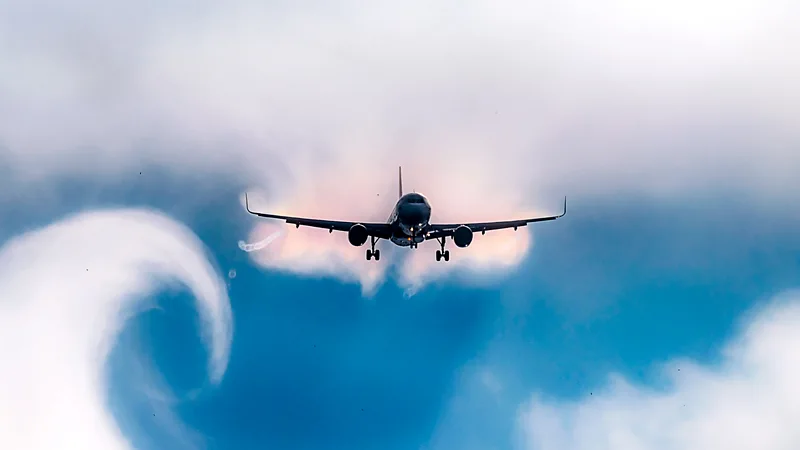
Climate change is creating stronger turbulence. Aircraft designers hope innovative new techniques will reduce its effects.
“We saw blood on the ceiling… It was just complete havoc.” This was one passenger’s description of the scene after a Singapore Airlines flight was hit by severe turbulence while passing over the south of Myanmar in 2024. A lot of people were on the floor.” Early this spring, a United Airlines Boeing 787 also hit severe turbulence while cruising above the Philippines. A flight attendant was thrown against the ceiling, resulting in a concussion and a broken arm.


Turbulence incidents like these are increasing as a result of human-caused climate change. Severe clear-air turbulence (Cat), meaning very rough air that is invisible to satellites, radar and the human eye, has increased 55% since 1979 – when reliable meteorological records began, according to research by Paul Williams, professor of atmospheric science at the University of Reading.


Turbulence is expected to treble worldwide by the 2050s and will likely have a major impact on routes across East Asia and the North Atlantic. It could affect people’s willingness to fly at all. Among the most common reasons people give when justifying a fear of flying are loss of control and a past experience with turbulence.
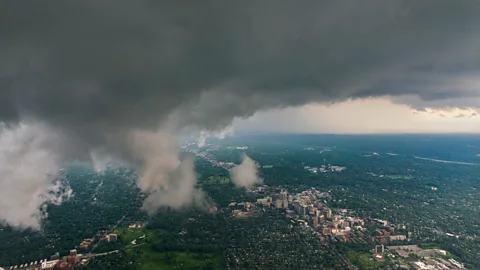
But turbulence, besides being potentially dangerous, also costs the aviation industry money, causing wear and tear to vehicles and lengthening some flights as pilots try to evade it. Such manoeuvres mean using up more fuel and increasing emissions. Although turbulence is usually a matter of discomfort rather than injury or death, the rising volume of chaotic motions in the atmosphere means airlines, scientists and engineers are faced with coming up with ways of mitigating the problem.
Turbulence Solutions based in Baden, Austria, has developed small “flaplets” that may be added to larger flaps (or ailerons) on aircraft wings. The flaplets adjust their angle slightly in order to counteract changes in airflow based on pressure readings taken immediately in front of them on the wing’s leading edge. It helps to stabilise the plane, a bit like how birds use tiny adjustments of their feathers while flying.
The common view is you can either avoid or accept turbulence and deal with it by buckling up and reinforcing the wing – Andras Galffy
The company says its technology can reduce turbulence loads felt by passengers by more than 80%. So far it has only tested the technology on small aircraft – though CEO Andras Galffy, himself an aerobatics pilot, feels confident that it will scale to support far larger planes.
“The common view is you can either avoid or accept turbulence and deal with it by buckling up and reinforcing the wing,” he tells me. “But we say you don’t need to accept it. You just need the right counter-signal. For light aircraft there was always this pain but even for commercial aviation it’s getting more serious because turbulence is increasing.”
Flying directly through eddies, vortices and updrafts with minimal disturbance requires not only precision engineering but a lot of advanced mathematics and an analysis of fluid dynamics. (Air, like water, is a fluid). The picture will always be complicated because the fundamental nature of turbulence is that it is chaotic. Small perturbations, from how wind deflects off a building to the wake of another aircraft, can change the behaviour of currents in the air. It’s hard for humans to comprehend, but it might be easier for AI.
“Machine learning is very good at finding patterns within high dimensional data,” says Ricardo Vinuesa, a researcher in fluid mechanics, engineering and AI at KTH Royal Institute of Technology in Stockholm. “Turbulence might just be the perfect application for AI.”
In a recent experiment, Vinuesa and colleagues from the Barcelona Supercomputing Center and TU Delft tested an AI system that controlled “synthetic jets” of air on a simulated aircraft wing. The AI itself was trained using deep reinforcement learning, a process whereby the model learns using trial-and-error, a little like when a toddler learns to walk. “Rather than measuring upstream, we can use AI to create very accurate numerical simulations of what airflow is doing based on measurements taken directly at the wing,” he says.
“And where neural networks are usually considered black boxes, we use explainable AI, which allows us to determine which measurements are most important to the predictions generated by the model.” Vinuesa and his colleagues are working with tech companies to develop the technology further.
About 20 years ago we could forecast around 60% of turbulence. Today it’s more like 75% – Paul Williams
Last year, a team from Caltech and Nvidia deployed extreme turbulence inside a wind tunnel to test an AI-powered sensing and prediction system for drones with promising results. Researchers at Nasa’s Langley Research Center tested a purpose-built microphone capable of detecting ultra-low infrasound frequencies created by whorls of clear-air turbulence up to 300 miles (480km) away.
Another approach that has been in active development since at least 2010 involves the use of Light Detection and Ranging (Lidar) to create a 3D map of the air around a plane, much as self-driving cars create a point cloud of nearby objects and vehicles, in order to navigate their environment. A 2023 Chinese study proposed a “dual-wavelength” Lidar system, which they claim can observe light-to-moderate Cat between seven and 10km (4.3 to 6.2 miles) ahead of the aircraft. Unfortunately, the lower density of air molecules at high altitude means the instruments become too large, heavy and energy-hungry to be of use in existing commercial aircraft.
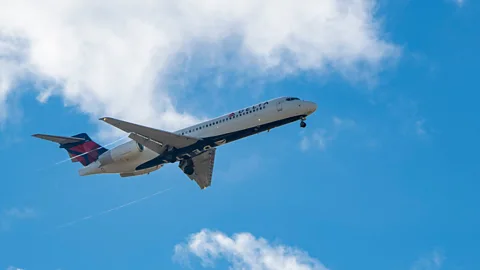
The convergence of manufacturing, AI and new sensors could transform aviation in the second half of the 21st Century. But what happens today? Before take-off, pilots check weather briefings and study jet stream charts. They consult flight planning software and check forecasts such as the Graphical Turbulence Guidance (GTG) to which Paul Williams contributed.
“About 20 years ago we could forecast around 60% of turbulence,” he says, “today it’s more like 75% and I suppose it’s my career goal to push that number up and up.” When I ask what holds back progress, Williams says it is access to turbulence data measured by aircraft. “Research scientists have to buy the data, and it’s not cheap.”
With advanced computation, AI and ever-more satellites, weather forecasting is improving, but there is a general lack of wind measurements above the Earth’s surface. What we do know comes from around 1,300 weather balloon sites around the planet and the accelerometers on roughly 100,000 commercial flights that take to the skies each day.
Turbulence Aware from the International Air Transport Association (IATA) anonymises and shares real-time turbulence data and is now used by airlines including Air France, EasyJet and Aer Lingus. For passengers, there are a growing number of apps that provide access to data seen only by pilots and dispatchers up to now, one of which is Turbli.
“I use Turbli,” says Williams. “I’ve found it to be reasonably accurate given the proviso that they don’t know your exact route so can’t be 100% accurate. But it’s a little like a hypochondriac googling their symptoms,” he adds. “I’m not sure it always helps.”
Credit: BBC