
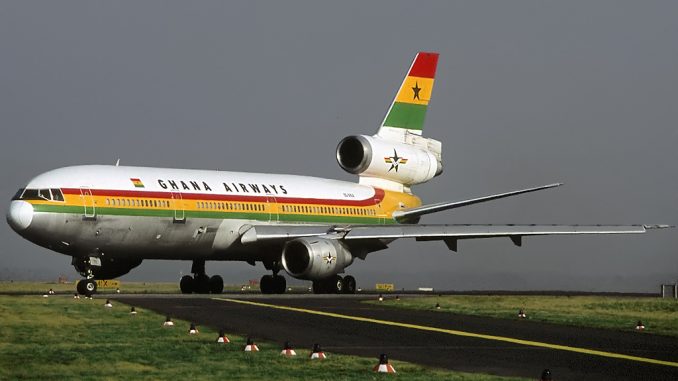
Following growing demands of air travel to and from Ghana, the country has signed an $877.5m provisional order with Boeing for three 787-9 Dreamliners in a move to relaunch the country’s national carrier. The agreement was signed at the recent Dubai Airshow.
According to the country’s Minister of Aviation, Joseph Kofi Adda, this development will give the country the opportunity to launch regional networks and service international routes in the nearest future.


“There is a growing demand for air travel to and from Ghana and we believe the advanced 787-9 Dreamliner gives us an efficient and flexible machine to launch a regional network and eventually serve international destinations in the future,” he said in a statement.


He further added that the government would retain a 10 percent stake while the remaining would be held by private investors in the country’s sector. This Public-Private Partnership (PPP) is a commendable decision going by the challenges that hinder the aviation sector in developing African countries. So far, Ethiopian Airlines is the leading African airline that has not had a habitual failure in the area of privatization, unlike others. It also services more than 60 international destinations around the world.
According to a statement by Ihssane Mounir, senior vice president of Commercial Sales & Marketing for The Boeing Company, Africa boasts a growing, young workforce and vast natural resources. He stated that Boeing “sees the demand for air travel continuing to rise across the continent” and “is honoured to work with Ghana in helping re-launch an airline to serve this vast market.”
With the deep-rooted involvement of private investors, Ghana’s aviation sector is expected to experience a dramatic improvement in innovation due to healthy competition. There would also be a growth in human capital development as a result of job creation which would impact its GDP.
Recall that a 2018 report by the Organisation for Economic Co-operation and Development (OECD), Africa has 731 airports and 419 airlines with an aviation industry that supports around 6.9 million jobs and $80 billion in economic activity. The International Air Transport Association (IATA) has also predicted Africa to become one of the fastest-growing aviation regions in the next 20 years with an annual expansion of nearly 5 percent.
But despite the economic potential of Africa’s aviation sector, several barriers have been classified as inhibiting factors to its growth. They include weak infrastructures that are deficient, dilapidated and outdated; high ticket prices caused by fuel price; poor connectivity and lack of private investment capital amongst many other challenges.
Air transport in Africa has admittedly suffered from several decades of poor investment, lack of strategic vision and tactical mismanagement. These factors exist as a result of stiff policies that most governments in the developing countries put in place to limit or completely restrict the involvement of private investors.
The Boeing 787-9 Dreamliner is part of a family of three airplanes that offer long ranges and unmatched fuel efficiency in the 200 to 350 seat market. The airbus can carry 296 passengers and fly up to 7,530 nautical miles (13,950 km) while reducing fuel use and emissions by 20 to 25 percent compared to older airplanes. With these fleets of airbuses, the west-African country would be serving a wider range of passengers and guaranteeing a wider distance coverage.