
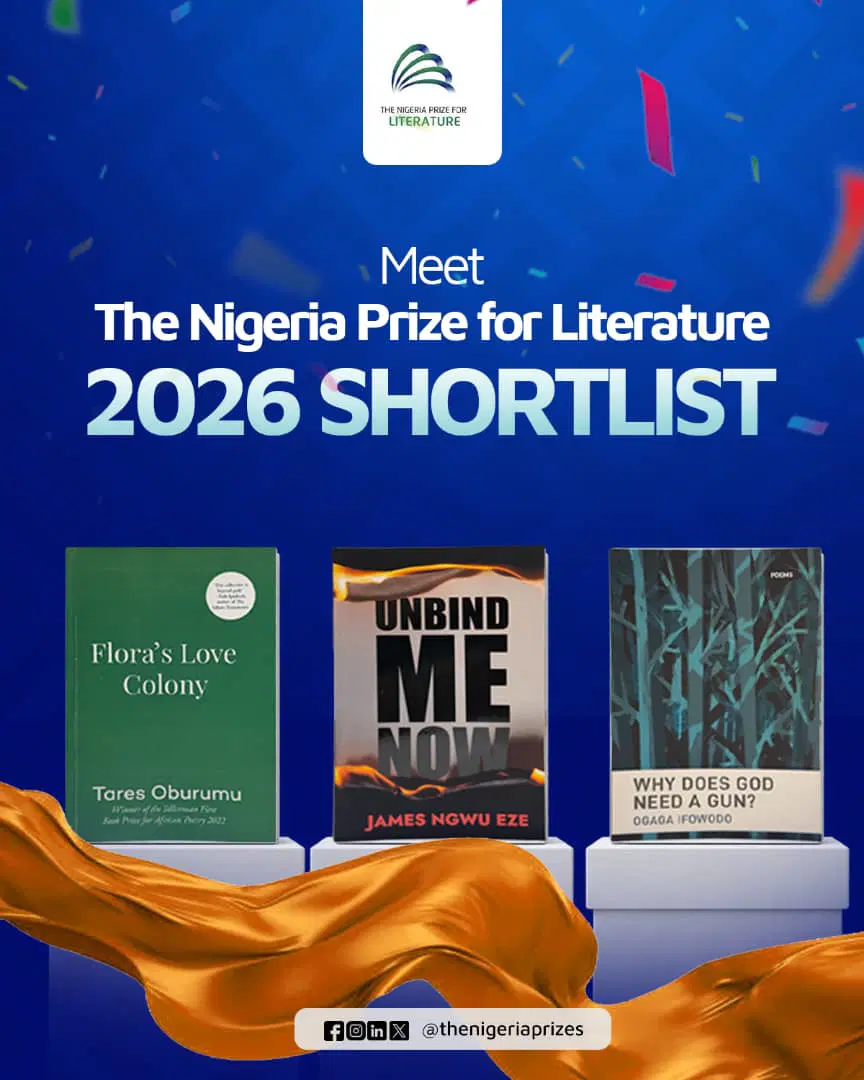
The Advisory Board of The Nigeria Prize for Literature has announced the final shortlist for 2026. Poets James Ngwu Eze, Ogaga Ifowodo and Tares Oburumu are now in the running for the `$100,000 award.
The authors made it through from a longlist of 11, which itself came from 223 entries submitted early this year.
According to the Advisory Board, “James Ngwu Eze, in Unbind Me Now, uses language that is fluid and aesthetically captivating. This collection decries the sociopolitical dysfunction of the nation and the world at large, interrogating the human condition, and charting a path for redemption. Ogaga Ifowodo, in Why Does God Need A Gun?, depicts religious and political violence in Nigeria, couched in a rich allegorical style. Delivered with the tripartite structure of body, mind and spirit, Ifowodo interrogates those forces that emblematise the world’s challenging ethos. While Tares Oburumu’s Flora’s Love Colony is written in a densely poetic style on Nigeria’s troubled history. It challenges mainstream narrative and is an inspiring socio-historical collection, captured in lucid imagery and evocative language.”
The shortlist marks the culmination of an intensive judging process that has placed the works under close scrutiny for their language, form, originality, craftsmanship and lasting literary value.
Commenting further on the shortlist, the Chairperson of the Advisory Board of The Nigeria Prize for Literature, Professor Akachi Adimora-Ezeigbo, said the selection reflects the depth and quality of contemporary Nigerian poetry, noting that arriving at the final three from 223 submissions was a demanding task for the judges.
She said the shortlist represents works that have distinguished themselves through their literary output, originality and ability to engage readers and the world around them.
The 2026 edition of The Nigeria Prize for Literature is dedicated to poetry, continuing the Prize’s annual rotation among four literary genres: prose fiction, poetry, drama and children’s literature.
Now in its 22nd year, The Nigeria Prize for Literature is sponsored by NLNG as part of its commitment to recognising literary excellence, encouraging creativity and contributing to the growth of Nigeria’s literary culture.
As the competition moves into its final stretch, the question is no longer who made the cut, but who will ultimately claim the prize. Three voices remain.