
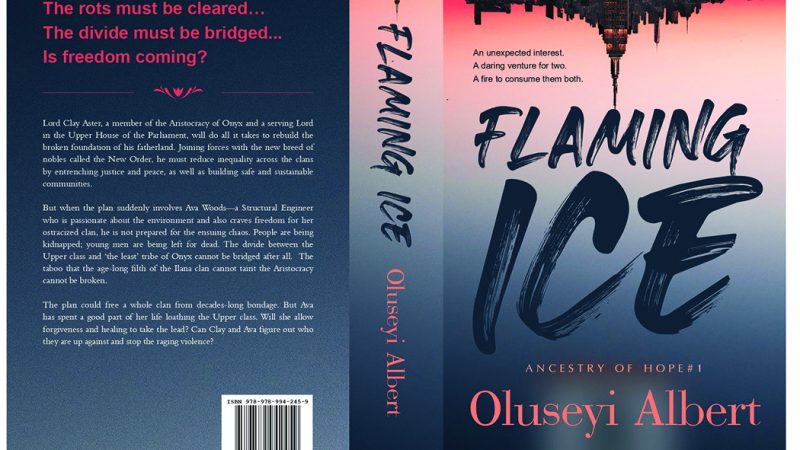
Oluseyi Albert’s Flaming Ice is a slow-burning crime thriller, its suspense punctuated by romance and a succession of unsettling incidents that keep the reader guessing until the final page. Set in Onyx, a fictional African country governed by a form of aristocracy, the novel follows the unlikely relationship between Ava Woods, a brown-skinned structural engineer, and Lord Clay Aster, an aristocrat and member of the Upper House of Parliament. What begins as a tentative romance gradually develops into a friendship that crosses the front lines of Onyx’s entrenched class divisions. Crime& Justice
At the heart of the novel is a struggle over power, privilege and social change, played out through a series of apparently isolated but ultimately interconnected events. Clay, as Lord Aster is known, belongs to the New Order, a progressive faction of the nobility seeking to dismantle the prejudices and inequalities embedded in Onyx’s social structure. His encounter with Ava reinforces his conviction that architecture and construction can become instruments for transforming not merely physical spaces but also the social structures that sustain class divisions.
Through Clay, Albert explores a model of leadership rooted in empathy and a belief that citizens should feel seen, valued and respected. The novel’s concerns also intersect with the United Nations Sustainable Development Goals, particularly in its treatment of sustainability, inequality, inclusion and social justice. These themes, however, are folded into a narrative that increasingly moves away from rhetoric and towards crime, danger and psychological suspense.
The novel’s central conflict is consequently multi-layered, combining crime, misplaced passion and class antagonism. Flora’s vicious attack on Ava over Clay recalls earlier warnings from some of Ava’s associates about becoming romantically involved with an aristocrat. Clay’s response reveals both his emotional investment in Ava and his determination to stand by her as a series of allegations begin to gather around her and her mother following the mysterious disappearance of members of Ava’s construction team.
Albert builds suspense through a succession of unnerving occurrences: an unknown caller, cryptic messages, missing individuals and threats. The detectives’ investigation gradually draws these seemingly disconnected events into a larger puzzle surrounding the abduction of the construction workers. Dialogue carries much of the investigation, allowing information to emerge incrementally rather than through heavy exposition.
The novel’s ecological concerns provide another layer to its social commentary. In spotlighting environmental degradation, poverty, oppression and discrimination, Albert holds up a mirror to recognisable social realities. The media persecution of Ava, in particular, evokes societies in which public opinion can be manufactured or manipulated by those with greater access to power and influence. Books& Literature
Ava and Clay’s shared desire to improve the lives of others eventually develops into an alliance that goes beyond civic responsibility. Their relationship is founded on a broader commitment to humanity, even as the circumstances surrounding them become increasingly perilous. Albert creates an effective contrast between Clay’s outwardly masculine assurance and Ava’s carefully guarded vulnerability, generating an emotional tension that leaves the reader hoping that the romance will survive the violence surrounding it.
The novel occasionally moves with an almost cinematic pace. Albert deploys quick-witted dialogue and introduces African languages, including Hausa and Swahili, to enrich the cultural texture of the narrative. Language also becomes a device for delineating the differences between Ava and Clay while establishing their intellectual parity.
Ava’s characterisation is particularly noteworthy for the restraint with which Albert handles her femininity. Rather than reducing her to a romantic object, the author foregrounds her professional competence and the complexities of her working life. Technical aspects of her profession are rendered in accessible English, while her exchanges with other characters are frequently enlivened by sarcasm and brisk retorts.
Clay, meanwhile, offers Albert an opportunity to revisit the rituals and anxieties of contemporary courtship. His aristocratic background makes him cautious about mixing romance with professional and social obligations. Instead of approaching Ava directly, he tests the boundaries of their relationship through hypothetical questions and indirect probes. Fine dining, outdoor excursions and restrained moments of intimacy subsequently enter the romance, although they remain shadowed by the threat of violence. People& Society
This alternation between pleasure and peril is one of the novel’s defining features. Albert balances fantasy and the more disagreeable realities of human existence, allowing romance to unfold against a backdrop of fear, crime and social inequality. The contrast gives the story much of its momentum.
The opening chapter, however, is weighed down by a concentration of sustainability rhetoric that may test the patience of some readers. Once beyond it, the narrative gathers speed, moving through a cascade of panic, fear, investigation and crime-fighting. The characters, meanwhile, remain less predictable than the prose initially suggests, their identities and motivations shifting as the mystery moves towards resolution.
Ultimately, Flaming Ice is an ambitious hybrid: part crime thriller, part romance and part social critique. Its eco-centric concerns and class-conscious world-building give the familiar machinery of suspense a distinctly contemporary frame. Albert’s most interesting achievement lies in making these competing strands—love, crime, ecology, privilege and social justice—coexist within a story whose real question is not simply who committed the crime, but what kind of society emerges when the structures that divide people are finally challenged.
Credit: This Day