
What's Hot?
‘Africans In Beijing’ Documentary Sparks Cross–Cultural Buzz
Sheffield DocFest Unveils 2026 Public Program: Over 100...
Crazy Flights: Kiss Frontman Produces Plane Disaster Movie
Oscar-Winning Sound Mixer Steve Maslow Dies At 81
18 Nigerian Music Talents Win $2m Berklee Scholarships...
Brooke Shields Says She Hasn’t Seen Michael Jackson’s...
Tupac’s Family Files Wrongful Death Suit Against Keefe...
We Lost Majek Fashek To Spiritism – Amos...
NFVCB Pushes For Kaduna As Hub For Indigenous...
Loyal Groundskeepers Guard Sudan’s Ancient Nubian Pyramids
  • Home
  • Arts & Exhibitions
  • Culture & Festivals
    • Culture Africana
    • Culture People
  • Fashion & Lifestyle
    • Music, Movies & More
  • News
    • Travel News
  • Opinion
    • Reviews (The Critics)
  • TCN Literati
  • Tourism & Hospitality
The Culture Newspaper
TCN Literati

Balkans Women Stage Ancient Greek Play To Condemn Women’s Suffering In War

by The Culture Newspaper November 23, 2024

Maja Mitic is Serbian. Zana Hoxha is Kosovar. Their adaptation of an ancient Greek tragedy highlights not so much the devastation war inflicts on women but women’s capacity to heal and resist.

Euripides’s “Trojan Women”, first performed in 415 BC, is an acerbic condemnation of the atrocities of war. It focuses on the misery and injustices the women of Troy endure after the conflict between their people and the Greeks.

The adaptation that Hoxha and Mitic are currently staging in the Balkans has a quite distinct focus.


Director Maja Mitic (C) gives instructions to actors during a rehearsal of the play “Women of Troy” at the Centre for Cultural Decontamination in Belgrade on November 21, 2024. – The play “Women of Troy”, co-directed by a director from Pristina and another from Belgrade, tells the stories of women after the wars are over. Sold, beaten, killed, their plague does not end with the battles, explain the two directors. But they hope that through the performance, they will help to launch a conversation between people speaking different languages, just like the actors on stage. (Photo by Vladimir Zivojinovic / AFP)

“In our version, we are moving forward by also taking care of each other, by finding ways to save our children,” said Hoxha, who directed the play.

It demonstrates “that amidst conflict and war, amidst hatred, women are the ones that find ways to resist,” she said of the play, being performed in Belgrade on Friday and Saturday night after two shows in Kosovo.

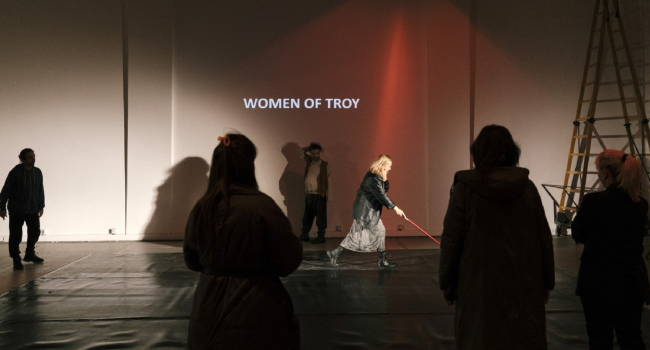
This production echoes the interminable discussions between the male politicians of Serbia and Kosovo who — a quarter of a century after the end of the war between Belgrade and its breakaway province — have still not concluded a lasting peace. The women negotiate on the soberly designed set.

As a Kosovar and feminist director “who still remembers war” and also the times of the former Yugoslavia,  43-year-old Hoxha said, “it was important to do this play because unfortunately it’s very relevant”.

Actor Shpetim Selmani performs on stage during a rehearsal of the play “Women of Troy” at the Centre for Cultural Decontamination in Belgrade on November 21, 2024. – The play “Women of Troy”, co-directed by a director from Pristina and another from Belgrade, tells the stories of women after the wars are over. Sold, beaten, killed, their plague does not end with the battles, explain the two directors. But they hope that through the performance, they will help to launch a conversation between people speaking different languages, just like the actors on stage. (Photo by Vladimir Zivojinovic / AFP)

– Transcending language –

In Euripides’s play, the women of Troy are married by force to their worst enemies, murdered and sacrificed on the tombs of men who fell in battle.

READ More  10 Fascinating Things We Learned About Kids In 2023

They are the victims of the war that follows war.

The tale needed two women to tell it, stressed Hoxha’s co-director Mitic, a prominent figure in Serbian theatre since the 1990s.

“The men, they make wars…  The consequences are on women and the children of these women,” she said.

Mitic plays Hecuba, the former queen of Troy, whose children are sacrificed, one after the other, to the follies of war.

Directors Zana Hoxha (C) and Maja Mitic (L) watch actors during a rehearsal of the play “Women of Troy” at the Centre for Cultural Decontamination in Belgrade on November 21, 2024. – The play “Women of Troy”, co-directed by a director from Pristina and another from Belgrade, tells the stories of women after the wars are over. Sold, beaten, killed, their plague does not end with the battles, explain the two directors. But they hope that through the performance, they will help to launch a conversation between people speaking different languages, just like the actors on stage. (Photo by Vladimir Zivojinovic / AFP)

She recites Euripides’s ancient text in Serbian.

Thaltybios, who comes to tell the women of their fate, replies in Albanian.

An English translation scrolls across the back wall.

After a few minutes, listeners can no longer distinguish the different languages because the pain is universal.

“The relationship, the emotions that these actors are able to carry are more important than the language barriers,” Hoxha said.

– ‘Art has power’ –

And whether they speak Serbian, Kosovar Albanian or English, the Trojan women make audiences reflect and make them angry.

“Even our characters are angry,” Hoxha explained.

Actors Shpetim Selmani (C) attends a rehearsal of the play “Women of Troy” at the Centre for Cultural Decontamination in Belgrade on November 21, 2024. – The play “Women of Troy”, co-directed by a director from Pristina and another from Belgrade, tells the stories of women after the wars are over. Sold, beaten, killed, their plague does not end with the battles, explain the two directors. But they hope that through the performance, they will help to launch a conversation between people speaking different languages, just like the actors on stage. (Photo by Vladimir Zivojinovic / AFP)

“They say like, you know, ‘fuck this shit, we don’t want this anymore.’

“‘Why are we suffering? Why do Cassandras have to exist today? Why does Andromache have to lose her child?”

At one point in the play, Hoxha recalled, Andromache says she wants to be able to walk around freely with her husband and son and not feel threatened in the street.

That feeling remains unchanged for women today, she said.

“There are only a few places in the world where I feel completely safe to be myself.”

“We are trying to change that,” she added.

READ More  10 Books Every Young Adult Should Read This Holiday

“I don’t think that the performance alone can do that. But art has the power to bring you something which maybe you didn’t even know existed.”

The emphasis in Hoxha and Mitic’s adaptation on the universal relevance of the protagonists’ concerns extends as far as their costumes.

Actor Aleksandar Stoimenovski performs on stage during a rehearsal of the play “Women of Troy” at the Centre for Cultural Decontamination in Belgrade on November 21, 2024. – The play “Women of Troy”, co-directed by a director from Pristina and another from Belgrade, tells the stories of women after the wars are over. Sold, beaten, killed, their plague does not end with the battles, explain the two directors. But they hope that through the performance, they will help to launch a conversation between people speaking different languages, just like the actors on stage. (Photo by Vladimir Zivojinovic / AFP)

The characters dress in black leather and ankle boots — a uniform that could belong to any army in the world.

Just as Hecuba could be any grieving mother on the planet.

It’s a story about women and war “in any part of the world, in any century, in any culture, in any religion”, said Mitic.

“This is the story that Euripides wrote centuries ago, but actually we see repetition of the same model during the war, after the war — raping, criminals, everything.

“What we see in this play, we really see today (in) Ukraine or Gaza, or (in) Kosovo or Bosnia” or wherever conflict is occurring including Somalia and Sudan, Mitic said.

After an hour in front of a packed hall, the voices combine, hoping for another future: “Sometimes to live is to resist,” they say.


ancientbalkanscondemnGreekinplaysstagesuffergsufferingtowarWomenwomens
0
FacebookTwitterPinterestLinkedinWhatsappEmail
The Culture Newspaper

previous post
Oba Of Benin Disowns Planned Igue Festival In Lagos
next post
A Historic Portrait Recovered by Monuments Men Trounces Estimate, Fetching $550,000 at Auction

You may also like

US Jewish Author Peter Beinart Receives PEN America...

April 28, 2026

Conakry Hosts 18th “72 Hours Of The Book”...

April 27, 2026

Cassava Republic Celebrates First-ever Women’s Prize Shortlisting

April 25, 2026

Stage Adaptation Of Best-Selling Children’s Book Comes To...

April 23, 2026

Two British Authors Among Writers Shortlisted For 2026...

April 22, 2026

Editors Should Not Upload Manuscripts To AI Without...

April 22, 2026

Shortlist Announced For The £25,000 Walter Scott Prize

April 21, 2026

Four Nigerian Writers Make 2026 Commonwealth Short Story...

April 16, 2026

Penguin Reveals 2026 Cover Design Award Winners

April 16, 2026

Burundian Writer Celebrates Cultural Heritage Through Children’s Tales

April 15, 2026

Leave a Comment Cancel Reply

Save my name, email, and website in this browser for the next time I comment.

Recent Posts

  • ‘Africans In Beijing’ Documentary Sparks Cross–Cultural Buzz
  • Sheffield DocFest Unveils 2026 Public Program: Over 100 World, International, European Premieres, Oscar-Stature Filmmakers, 100th-Birthday Tribute To David Attenborough
  • Crazy Flights: Kiss Frontman Produces Plane Disaster Movie
  • Oscar-Winning Sound Mixer Steve Maslow Dies At 81
  • 18 Nigerian Music Talents Win $2m Berklee Scholarships Through Tiwa Savage Foundation Programme

Sponsored

Recent Posts

  • ‘Africans In Beijing’ Documentary Sparks Cross–Cultural Buzz

    April 30, 2026
  • Sheffield DocFest Unveils 2026 Public Program: Over 100 World, International, European Premieres, Oscar-Stature Filmmakers, 100th-Birthday Tribute To David Attenborough

    April 30, 2026
  • Crazy Flights: Kiss Frontman Produces Plane Disaster Movie

    April 30, 2026

Categories

  • Arts & Exhibitions
  • Culture & Festivals
  • Culture Africana
  • Culture People
  • Fashion & Lifestyle
  • Food
  • Music, Movies & More
  • News
  • Opinion
  • Photo News
  • Reviews (The Critics)
  • TCN Interview
  • TCN Literati
  • Tourism & Hospitality
  • Travel News
  • Travel Trends
  • Travelogue
  • What's Hot?
  • World Culture

Connect with us

Connect with us
  • Facebook
  • Twitter
  • Instagram
  • Youtube
  • About Us
  • Advertise With Us
  • Privacy Policy
  • Contact Us

@2025 - The Culture Newspaper. All Right Reserved. Maintained by Freelart

The Culture Newspaper
  • Home
  • Arts & Exhibitions
  • Culture & Festivals
    • Culture Africana
    • Culture People
  • Fashion & Lifestyle
    • Music, Movies & More
  • News
    • Travel News
  • Opinion
    • Reviews (The Critics)
  • TCN Literati
  • Tourism & Hospitality