
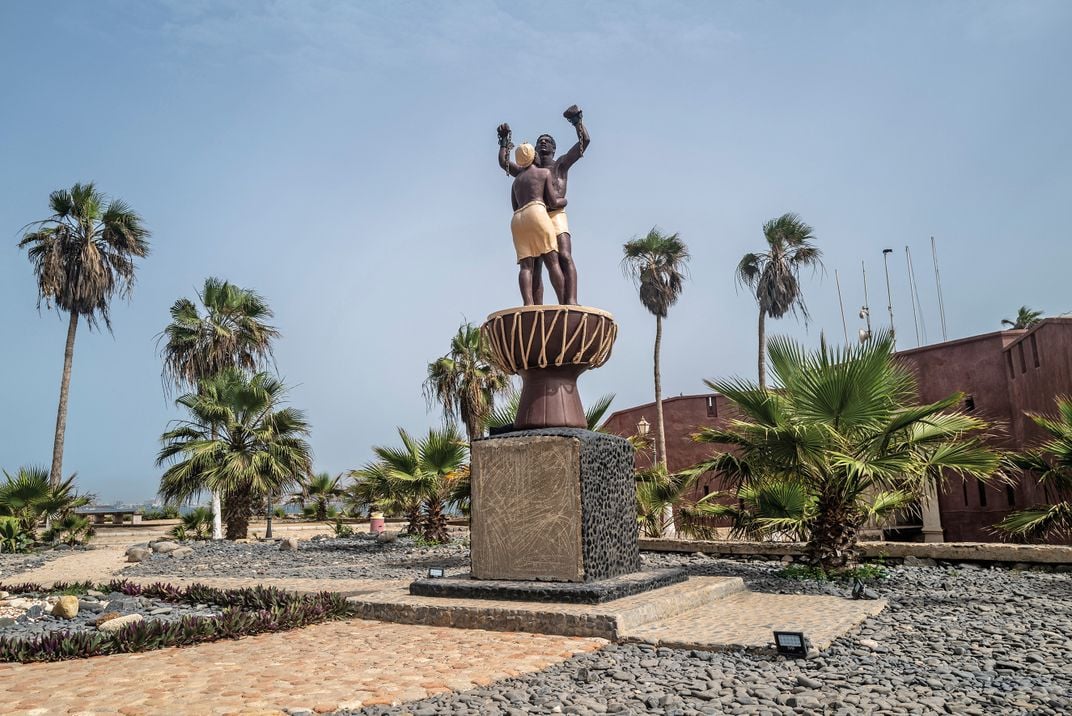
One hot day in November 2017, Hasani Carter, a genealogist and middle school science teacher from Columbus, Ohio, walked the dusty path to the confluence of the Ezu and Omambala Rivers just outside of Aguleri, a village in southeastern Nigeria. The sun pounded down on his head as he neared the placid waves. Surrounded by dozens of members of the village, he and others he was traveling with were guided into the shallow water, where Eze (King) Chukwuemeka Eri, the traditional ruler of Aguleri, slowly poured water over their heads. “He baptized us and reinstated us into the community as Igbo,” an ethnic group, Carter recalled recently. “He absolved the hardships of the trans-Atlantic slave trade. The eze took us to a shrine afterward; it was a white building with a thatched roof. We bowed, and he gave us our Nigerian names. Prince Chineme Eri is my name. It means ‘God’s gift.’ It was the most amazing experience of my life.”
Carter, 40, had traveled to Africa with Roots to Glory, a Maryland-based company that helps Black people, particularly descendants of those enslaved in the U.S., connect with their ancestral lands and people. Since the company was founded a decade ago, it has hosted hundreds of travelers on custom-designed pilgrimages to countries all over West and Central Africa. Many describe the experience as a homecoming celebration, a cultural exploration and a spiritual awakening all at once. “The very first village that I went to was the village where my ancestors walked,” Carter said. “I was more myself there than I am in Ohio. I didn’t have to think about my Blackness. I felt freer—fully free.”


The Distinctive Ears of the Eurasian Lynx are a Mystery


Roots to Glory is one of a number of heritage travel companies benefiting from the widespread popularity of at-home DNA testing through outfits like Ancestry and 23andMe. Because it is especially difficult for descendants of enslaved Africans to trace their family histories, African Americans have reaped particular benefits from these services, adding to an already robust online ecosystem devoted to African American genealogy that has traditionally made use of recorded family stories, oral histories, census data and other official documents. One group, Our Black Ancestry, a nonprofit organization, has a database of more than 12 million people abducted from Africa—including more than half a million who were enslaved in the United States. AfriGeneas, which focuses on African American genealogy, has a Facebook community of 17,000 members.
“I started Roots to Glory because I knew there would be people who would want to know where they came from after taking DNA tests,” said Ada Anagho Brown, who founded the company in 2012. Brown, a 5-foot-tall, charismatic ball of energy who is now in her late 50s, was well positioned to help people connect with their African heritage. She grew up in Cameroon, the daughter of the chief of the Ngwo village, and she has a deep love for her Central African heritage and culture. She fondly remembers walking for miles through her village and greeting every person she encountered. She recalls rituals in which adult masqueraders in traditional costumes of straw and masks chased her and her friends around. She snacked on grilled grasshoppers, but her favorite food was her mother’s eru, a hearty soup made from green vegetable leaves, meat and palm oil, which is now considered one of Cameroon’s national dishes.
In 1975, when Brown was 10, her father, who was also a colonel in Cameroon’s military, received a diplomatic posting in Washington, D.C., and the family relocated to a Maryland suburb. Her first years in the States, where she was enrolled at an international school, were welcoming. “There were lots of Africans and people from other countries,” she said. “It was a true melting pot.”

But at the local public school there was less diversity and open racial hostility. White schoolmates called her racist names—the N-word, a “token.” She was even more mystified by what she felt was a cold shoulder from some Black people. “They’d say Africans lived in trees, or that I talked different, and that I thought I was better than them,” Brown said. She remembers trying to hide her accent to avoid the ridicule. She couldn’t understand how African Americans she encountered didn’t feel a bond over their shared history, but when she pointed out this bond, she was rejected. “It saddened me that people have negative views of Africa. Their ancestors were removed from Africa. We were the family left behind.” At the same time, some African Americans report being referred to as “white” by the locals when they visit African countries, emphasizing the cultural disconnect. “I’m a unicorn,” Brown said. “I straddle two continents. It was important to connect the two.”
After culinary college, Brown settled in Baltimore, married and had children. For years she organized cultural events, like African dance performances in the Baltimore-Washington area, and when her kids grew older she volunteered for a small nonprofit that worked with African ambassadors to help Americans who wanted to trace their African heritage.
In 2010, Brown, who by then had gained a reputation as an expert in African cultural affairs through her work with the nonprofit and her community events, was approached by a group of African American friends of hers who had taken at-home DNA tests and discovered their Cameroonian ancestry. Eager to learn more about their origins, they asked Brown to escort them on a trip to the country in an effort that ballooned to the size of 54 people and eventually involved several local nonprofits. As it happened, Brown was already toying with the idea of starting a DNA testing company, and she had established relationships with village leaders in Cameroon, Ghana, Ivory Coast, Benin and other countries.
Brown traveled back to Cameroon on her own and brought DNA testing kits with her. She asked members of the Bamoun ethnic group, whose DNA frequently appears in African American genealogical research, to provide samples that she later had tested through Ancestry. She found matches. The following year, when a group of Americans made the trip, they connected with long-lost cousins. Many developed lasting bonds with these distant relatives.
“I witnessed how profound it was for these participants to walk on their ancestral land,” Brown recalls. “One woman took a photo of her grandmother and placed it on the Cameroonian shoreline and said, ‘Now there will be no more shame.’ The joy you get from knowing where you came from is so important. It was so fulfilling to see. I knew I had to make it into a business.”


Soon, Brown was guiding small groups of African Americans to ancestral homelands all over West and Central Africa, including Cameroon, Nigeria, Benin, Sierra Leone and Senegal. The majority of the enslaved Africans—and their descendants—in the United States have roots that lead back to these regions, according to DNA analysis.
At first, she was organizing one trip a year. By the time the coronavirus pandemic halted international travel in 2020, she was leading about four trips a year. She is now organizing trips about twice a year.
For many people who travel with Roots to Glory, these journeys represent the culmination of years of research—the final piece of the puzzle after having actually located African relatives. “I didn’t go to Nigeria as a tourist,” said Carter, who met several distant cousins during his trip. “I went as someone who had family there. I literally went home.”
Brown’s approach to organizing trips is extremely personalized. “I don’t plan a tour until I know who’s in the group,” she said. An itinerary might include visits to specific ancestral villages, naming ceremonies and tours of historic sites associated with the slave trade—for instance the notorious “slave castles” where Europeans traded in people along the coast. Visits to restaurants, marketplaces and museums help participants understand daily life and local history.


Many clients find particular solace in paying homage to their ancestors at the sites related to their enslavement. Denise Rolark Barnes, a newspaper publisher in Washington, D.C., has traveled with Roots to Glory several times, including trips to Ghana, Cameroon and Benin. “We walked the paths where Africans walked during the slave trade,” she told me. “You feel their spirits, their presence. We took off our shoes in reverence to them. We saw the remnants of buildings where they imprisoned the enslaved. It’s empowering, because you realize you’re the descendant of a person who made it. They were captured, shipped across the water, had children—and here I am. It makes you say, ‘Who has the nerve to complain about anything, based on what my ancestors survived?’ It was a heart-opening experience.”
While some historic sites are included, Roots to Glory trips are not designed for people with general tourist sensibilities. Groups frequently visit orphanages and schools to bring supplies and speak with children and educators about their lives. They also spend extended time inside the homes of local people or relatives, often staying the night. “When you’re able to go into somebody’s home, and they welcome you and talk about their lives, that’s insight that you wouldn’t normally get on tourist trips,” Barnes said. “That’s what is so valuable. You get to know the people of the country—not just the country.”

Recently, Roots to Glory has partnered with the William Lockridge Community Foundation, a Washington-area nonprofit, to send Black children and teenagers to Africa on trips of cultural exchange. “Children can’t be what they can’t see,” said Wanda Lockridge, who named the philanthropic foundation after her late husband, a prominent educator, activist and public official in Washington. “I want to help kids who don’t have the opportunity to travel to see where their ancestors came from.” She went on, “Kids can learn so much outside of the classroom. Our middle schoolers realized that they had privileges that not everybody has. They met students that couldn’t go to school because of money. They saw young children carrying water for their families and helping their mothers sell at the market. One student admitted that she didn’t even do her chores at home, but now she realized how many privileges she had and decided to help her mother more.”
Over the years, as Brown returned again and again to Africa with her clients, sharing dozens of meals in the homes of local villagers, she came to feel that food was at the heart of the bond between Africans and African Americans. So in 2020, she co-founded the Muloma Heritage Center, a nonprofit organization in St. Helena, South Carolina, dedicated to celebrating African influences in American culture, in particular African American cuisine. “I decided that my legacy would be to help people understand the contributions that Africans have made in the U.S.,” she said.
The timing was not a coincidence. When the pandemic started, Brown feared she might not get to return to Africa with her groups, and she worried especially that a generation of young people might never get a chance to visit the continent. But the idea for the center had actually been planted years earlier, when Cornelia Bailey, an unofficial historian of the Gullah Geechee, an ethnic group with roots in the South, approached Brown about a new initiative. At the time, the Gullah, who are descended from enslaved people abducted from the rice fields of Sierra Leone and other West African countries specifically for their agricultural expertise, were facing down developers who were buying large portions of their Lowcountry ancestral lands in South Carolina, North Carolina and Georgia’s coastal plains and Sea Islands. Bailey asked Brown if she could help organize a group—most of whom were Black chefs—to purchase and protect the land. Because the area’s isolated, swampy, malaria-prone conditions had made it uncomfortable for enslavers to live there consistently, Gullah people were able to retain their Indigenous African language, traditions and culture with little interference. “The land, the customs, the people—it’s the closest you can get to Africa in the U.S.,” Brown said.
After an organizing drive that included a $1.8 million grant from the Mellon Foundation, the group was able to buy 38 acres of historic Gullah land. “We started planning, and at first we wanted a farm, then a museum, then a cultural center,” Brown recalled.
The Muloma Heritage Center—the word, from the Mende language spoken in Sierra Leone, means “we are together”—will encompass all of those things and more. The center will have a working farm that is on track to be up and running by summer 2024, growing rice, peppers, tomatoes and other traditional crops. It will also act as a cultural storehouse, with archives of heirloom seeds, cookbooks and recipes, and will host culinary workshops and demonstrations, tracing foodways all over the African diaspora. “Mende women are legendary cooks,” Brown said. “They can take grass, put it in a pot with a little salt, and it will taste good.” In the spring, construction will begin on a series of structures that will showcase how culinary traditions evolved, from traditional African houses to Southern farmhouses. “It’s not just cooking,” said Brown. “It’s culture.”
In March, I joined Brown and a group that included about a dozen prominent African American chefs on a trip to Cameroon to learn about African culinary techniques. Brown chose to visit Cameroon because its diverse landscapes make it a varied resource for plants, land animals and seafood. The country is so ethnically diverse that it’s sometimes nicknamed “Africa in miniature.” And by some measures, it has the richest culinary traditions on the continent.
When we arrived in Douala, a coastal city with a population of close to three million, on a sticky evening, the thick air was perfumed with the sweet scent of puff puff, or small doughnuts, fried in oil and served with beans as a popular street food. The city hummed with traffic. Local minibuses decked out in vibrant colors and crammed with passengers careened down jagged roads. Hawkers with everything including beverages, fried snacks and sandals piled neatly atop their heads wound their way through cars and crowds. It could have been an overwhelming experience, except that Brown was there to explain, translate and guide. Among our group was Michael W. Twitty, a culinary historian and award-winning author of books such as The Cooking Gene and Rice: A Savor the South Cookbook; Mashama Bailey, James Beard Award-winning chef at The Grey restaurant in Savannah, Georgia; David K. Thomas, a grand champion on the reality show “Chopped”; Kenyatta Ashford, of Neutral Ground in Chattanooga, Tennessee; and B.J. Dennis, of Lowcountry Fresh Market and Cafe in Bluffton, South Carolina.


As we traveled through several villages and towns, Brown encouraged the chefs to engage with the people and local culture. “Open your mind and meet people where they are, not where you expect them to be,” she told them. “Africans struggle, but they aren’t poor. They have hope and hustle.”
In Douala, we dined on an expansive buffet of dishes representing culinary traditions from the east, central and western parts of the country. There was crawfish cooked with spinach, savory soups oozing with red palm oil, and mounds of rice sprinkled with onions and shrimp. A live band playing jazz and West African hits serenaded us as we stuffed ourselves well into the night. On the road to Foumban, a Bamoun village, a herd of cattle moved alongside our bus, weaving between motorbikes and cars. We walked through a vast courtyard to the palace of the king of the Bamoun, a quick-witted 30-year-old who was educated in New York and recently installed as the village’s monarch. We were granted an audience with the king, who told us about his life. Then a band of musicians and dancers performed in a circle outside the palace.
In the beachside town of Kribi, the chefs learned how to make pepper soup over an open fire. We sat around the flames, the waves splashing in the distance, slurping up the flavorful soup from bowls made of calabashes.

Later, at a fish and spice market in town, Brown pointed to traditional ingredients used in popular dishes like sangha, a stew of maize, palm nut juice and cassava leaf, and njama njama, huckleberry leaves used to roast corn. She grabbed a handful of round seed-like plants called country onions and instructed the chefs to smell the herbal seasoning. The chefs learned about traditional preparations and spices as well as alternative ways to use them back home. As everyone was buying bottles of white peppercorns, a few locals walked up and smiled. “You are very welcome,” said a man wearing a New York Yankees baseball cap, in halting English. “We are happy you have come back.” Two women in the group became teary-eyed at the recognition. It was the sort of acknowledgment for which many Black Americans long.
Twitty described the experience as rediscovering an essential part of himself that he didn’t even know he was missing. “Black Americans should visit Africa so that they can connect with that part of us that the West has no language for,” he said. “To visit Africa is to reunite with a deep part of your soul.”
For some of Brown’s clients, rediscovering that connection transforms them so completely that they decide to repatriate to countries in Africa. Some have been given land as a gift by local chiefs or villages to which they trace their heritage; others have purchased land collectively. One group of about 20 people, whom Brown is helping prepare for the move, owns 50 acres of land near the coast in Ghana, where they are currently building new homes.
As for Brown, home remains with her family, in Baltimore, but it’s also across the vast Atlantic. “Home is 54 countries—our continent is my special place.”