
Mathematical 7 Goes on Stage: Segun Odegbami, Abeokuta, and the Making of “Ayinla” by Tunde Kelani
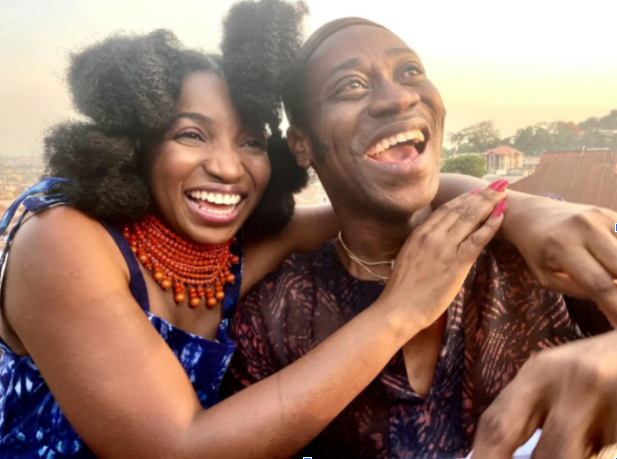
In this closing conversation with Segun Odegbami, Mathematical 7 speaks on his acting experience in “Ayinla”. All photos include some of the lead actors and scenes in the movie.


Unedited Transcript


Toyin Falola:
You wrote about a visit you made to the residence of Professor Wole Soyinka with Tunde Kelani. Many have wondered what a literary genius and teacher, a foremost cinematographer and Film Maker, and an exceptional Football player could have in common? Tell me about the genesis of the visit and the encounter itself.
Segun Odegbami
Tunde Kelani has been my family/friend forever – almost 50 years. He knew my elder brother, Dele, during their secondary school days in Abeokuta.
The elements were at mysterious work when TK and I lived briefly together in the home of a friend mutual to ‘Badmeat’ (as my elder brother was called at the time for his wicked tackles on opponents in football) and TK in Ibadan. That was in 1972.
TK and I also worked briefly around the same time in WNTV/WNBS, and, later in life, connected again in Lagos where we had a few close, mutual friends – Yinka Craig, Tunde Oloyede, Tunde Adegbola, and so on, from the mid-1970s. We became neighbours again in FESTAC Town for over a decade, meeting for coffee and conversation many evenings in TK’s home, in the late 1980s till the mid-1990s.
We remained very close throughout. I was an integral part of TK’s family, just as I was in the periphery of his film projects for decades. I just enjoyed listening to his endless stories, film after film, and he enjoyed hearing the comments and opinions on his works as seen through the untrained eyes of a football player. Once, he showed the premiere of one of his movies in my house with an assembly of our two families over a feast and plenty of drinks.
He inspired and smoothened my path into the audio/visual world, helping me successfully navigate the challenges of sports TV production without any formal training in the 1990s.
I have remained around the TV production business till now, and I am in the process of setting up sports radio and television stations as a business and public service and as a production centre for films, documentaries, capacity training, scholarship and research.
During some of our conversations a long time ago, TK found out that my Uncle, my father’s immediate elder brother (by the same father), was the same well-known writer, Amos Tutuola. When the man died in 1990, TK desperately wanted to speak with my father to get complete information about his brother. That’s how TK came to interview my late father. That’s when I also heard more about my uncle and stopped wondering where my inborn interest in storytelling, literature, the arts and Yoruba cultural issues sprang from. Uncle Amos and I are from the same genetic stock.
Amos Tutuola was originally Amos Tutuola Odegbami. His children still bear the Odegbami surname. He lived in Ibadan, and my father used to go and visit him in the early days of my sojourn in the town in the early 1970s. I took my father a few times to his brother’s house in the Apata area of Ibadan.
My father told us about his famous brother and how they were all shocked by his global fame. Like the rest of them (brothers), he had minimal western education, only as much as their mothers could afford or arrange with other relatives to give them. My grandfather did not send any one of his children, from many wives to school.
Amos wanted very badly more education than the few years in primary school that he had. He was so angry later in his life with their father that he dropped his surname from his name and decided to bear his mother’s surname when the unexpected path to fame opened up through his writings.
My father, who only had a standard four education, and could read and write, never had a copy of the famous book, “The Palm-Wine Drinkard‘, that made his brother famous during my childhood years in the 1960s Jos where we lived.
I believe, like his brother, my father was a master at telling us folkloric stories on some moonlit nights in front of our house at 64/5 Yandoka St. in Jos. Later in my life in Ibadan, I once tried to read the book. I was amused at the relatively ‘bad’ English it was written in and did not read far enough into it to appreciate the fascinating fantasy, imagery and creative mind of Amos Tutuola.
TK’s enquiry many decades later triggered my interest to reread it. This time I enjoyed reading it. TK enthusiasm for telling stories on Fagunwa, Bayo Faleti, Akinwunmi Ishola, and other Yoruba writers opened my mind to Nigerian literature and writers, including Wole Soyinka, and their relationship.
I went to Roman Catholic Primary and Secondary schools. We studied Thomas Hardy, William Shakespeare and the Anthology of Longer Poems for literature in English. I did not read and was never exposed to any African writers.
Once, at the prompting of TK, when I tried to read Ake by Wole Soyinka purely out of curiosity to read a Wole Soyinka book, I could not go beyond the first chapter. Navigating through the words and style of his writing were too difficult. I laboured in reading it. I later read ‘The man died’. I did not find the true-life story fascinating reading. Recall that I grew up feasting on the diet of ‘James Hardley Chase’ for my novels and Thomas Hardy and Jane Eire for my more serious school work.
During my football playing days, reading novels was my pastime in camp. I loved to read all manner of books. Every time I travelled abroad, the first thing I did (and still until today) visits WH Smith and charter books and novels.
As I grew much older, particularly after my footballing years from the mid-1990s, and had new friends, many of whom were in academia or the arts, my mind started to be fertilised with a different mindset about literature.
Many persons around me, led by Tunde Kelani, were ardent ‘disciples’ of Wole Soyinka – Tunde Fagbenle, Tunde Dabiri, Tunde Makanju (Capone), Peter Badejo, Uncle Tunji Oyelana, Tunji Odegbami (Capone), Rufus Orisayomi, and so on.
Through the years, I was always fascinated when they discussed and spoke so glowingly of Prof Wole Soyinka and their different rather unique relationships. Everyone had incredible stories to tell about Kongi. He was like a god.
Yet, in all my ‘walkabouting’, my path with the great man never crossed. We met once at the airport, but with people milling around him, I never had the space to approach him and introduce myself; after all, a smaller crowd milled around me too. Remember that I was a little bit of a celebrity too at the time. Even when TK finally did the introduction at his 60th birthday celebration that Prof attended, it was so flitting that I could never have registered in Prof’s mind. A footballer’s name or face would be the last thing to register on the Prof’s sophisticated mind. TK’s introduction was drowned by the noisy tenor of the evening. My name would have flashed and faded immediately through Prof’s mind. Football and scholarship did not go together in the world of scholarship and intellectualism.
I was so frustrated not being close to WS, like all my friends, that I got Prof’s email from TK, sent him a short message introducing myself, shockingly received a warm response, and started a conversation thread that lasted quite a while with one of the greatest living literary giants in the world. For that period, I lived on the moon.
One day, WS actually agreed to meet with me in Lagos at Uncle Yemi Ogunbiyi’s. Uncle Yemi is one of my late cousins, Tunji Odegbami’s best friends. He knew me very well.
That’s how I met Prof, one-on-one, for about 30 minutes for the first and only time before I had the better opportunity to meet him again over a decade later with the preparations for the filming of ‘Ayinla’ by TK.
This time it was so close to home in Abeokuta. TK asked if I wanted to fulfil my dream to visit Professor Wole Soyinka in his Abeokuta residence in the ‘jungle’ of Kemta. I jumped at the chance.
TK told me he needed to brief Prof about the new film project and to secure his blessing. He told me he never did any film production involving Professor Wole Soyinka, mainly since several were adaptations of books and plays written by renowned Yoruba scholars. TK told me he had secured a ‘visa’ for me, that is, permission to bring me along.
TK is very close to Professor Wole Soyinka. They have an umbilical relationship through their mutual work, passion and life in the arts. So, that’s my story. That’s how a film-maker, a writer and teacher, and a football player found themselves in ‘Ijegba’ for an uncommon conversation.