
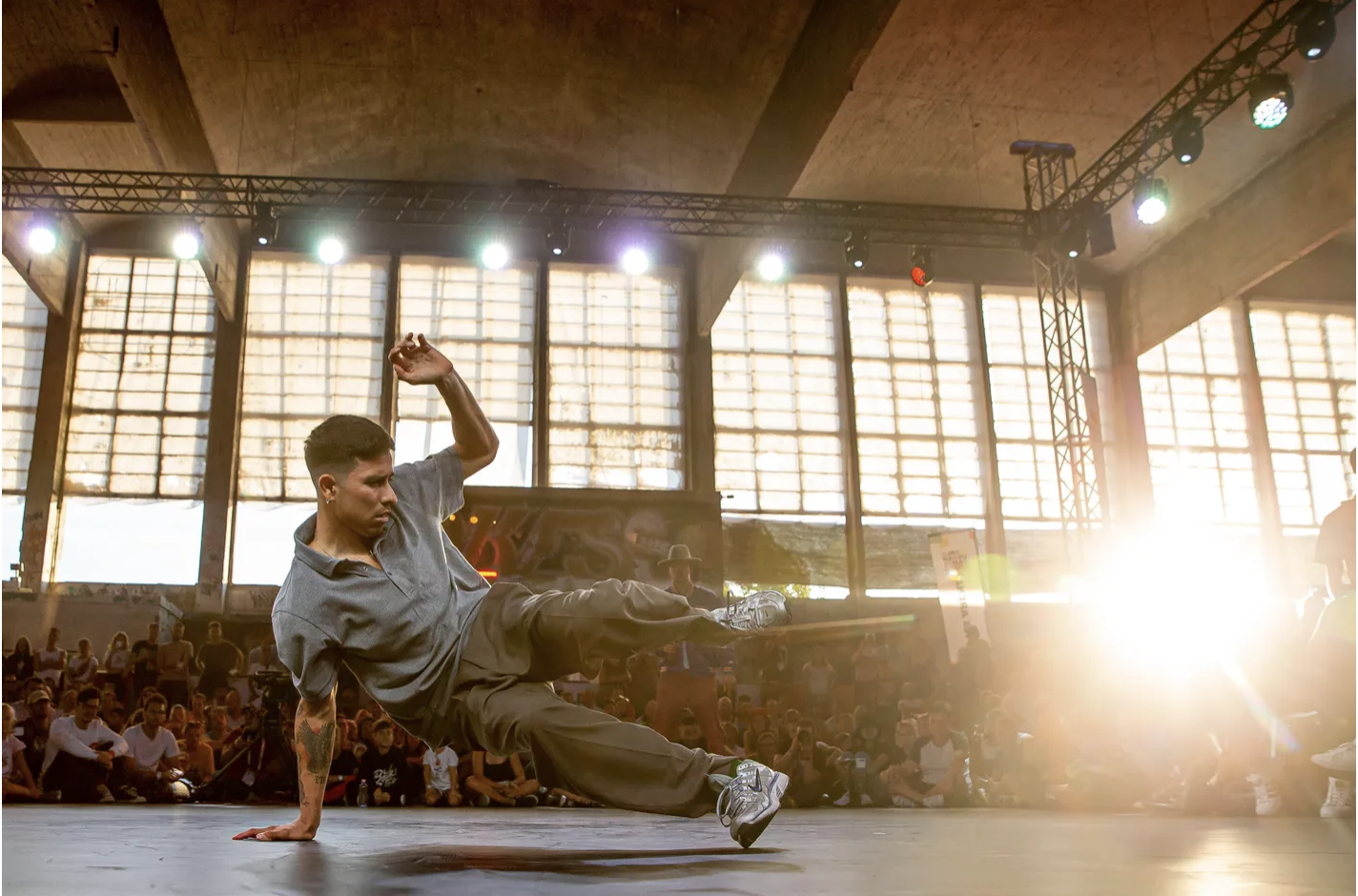
We all associate the Olympic Games with sport, with physicality, with beauty and even artistry. The Summer Games scheduled to take place in Paris 2024, however, are slated to bring us something new. For the first time, dancers will compete in the Olympic Games, as breaking makes its debut.
Dance as a sport has long been a subject of sometimes heated discussion. Is dance a sport? Or is it an art? Does dance in competition reduce its artistic value to nothing but a series of numbers on a page?
Jean-Laurent Bourquin, senior advisor for the World DanceSport Federation (WDSF), which was entrusted by the International Olympic Committee to oversee breaking at the 2024 Paris Games, says that there was initially some reluctance from the breaking community.
“We had some people complaining, saying, ‘Oh, we are not sure that this is good because it will transform breaking,’ ” says Bourquin. There was a fear that Olympic rules would impose constraints on freestyling creativity.
“But these questions were completely answered after breaking’s success in the Buenos Aires Youth Olympic Games in 2018,” he says. “All the judges were from the community—people like Crazy Legs, Mounir, Narumi, Moy and Jeskilz. Breaking was perfectly delivered with full respect of the culture.”
Why Breaking? Why Now?
Breaking is one of four new sports that are confirmed for the Paris Games, along with skateboarding, sport climbing and surfing.
“In our fast-changing world, you cannot rest on yesterday’s success,” the IOC press office told Dance Magazine. “Constant improvement and evolution is needed. Accordingly, we have also undertaken the most comprehensive reform of the Olympic program in our recent history.”
The IOC’s “Olympic Agenda 2020” outlines 40 recommendations for updating the Olympics. One is to introduce more flexibility to allow host cities to propose new sports to their editions.
The IOC also recognizes that “sport needs to adapt formats to go where the young people are, to continue to inspire the younger generation with the Olympic values of friendship, excellence and respect.”
Bourquin explains this mindset in the context of Paris: “The IOC was looking for sports that embody a Paris 2024 vision, aligning with the key criteria of promoting the Games: sustainable, inclusive, urban, youth-oriented, spectacular and gender-equal. And, of course, breaking fully meets these criteria.”
Institutionally Organized, Community Driven
The WDSF began in 1957 and now carries the mission of driving and developing dance sport around the world in a modern, sustainable and structured manner. With an international institution attempting to regulate a non-institutionalized culture like breaking, it’s not surprising that there would be hesitation from the breaking community.
“I was very skeptical,” recalls renowned breaker Niels Robitzky, aka “Storm,” “because we’re talking about an art form that had no boundaries, really, social boundaries. But when it is featured as a sport at the Olympic games, then there will be certain restraints.”
Yet once Robitzky was connected with organizers, he learned they were interested in presenting breaking authentically, in the same way that the breaking culture puts it forward in their own battles, he says.
“WDSF is bringing the structure through the national federation, and the breaking community is bringing the purity of the art form,” explains Bourquin, adding that WDSF is working with opinion leaders of the breaking community to ensure the competition is delivered with full respect of the culture.
Competition Structure and Scoring
Sixteen b-boys and 16 b-girls will compete in Paris, chosen through qualifying events organized by WDSF on five continents.
There will be no numbered scoring. Instead, the competition will be structured in battle format, true to b-boy/b-girl culture: tournament-style, one-versus-one. The winner of one battle moves on to face the next challenger, and the winner of that battle moves on to the next. The last dancers standing will be the Olympic champions.
The criteria are not yet official, but in Buenos Aires they included technique, variety, creativity, personality, musicality and performance. These are divided into three main dimensions: that which is connected to the body, or physical quality (technique and variety); that which is related to the mind, or artistic quality (creativity and personality); and that which is connected to the soul, or interpretative quality (musicality and performance).
“I was the architect of the judging system,” says Robitzky. “The idea came from the trinity of mind, body and soul.”
The final five judges for the Paris Games have not been chosen yet, but Bourquin says that they will be former dancers who have the ability to evaluate others impartially.
“We have to ensure that decisions are fair, objective, transparent—because for us, the integrity of the results is the most important,” he says. “We cannot allow a judge to pick a winner just because they are good friends.”
Is This Just the Beginning?
Now that breaking’s Olympic debut is official, will this open the door for other styles of dance to enter the iconic competition?
“Our immediate objective is to properly deliver breaking, and this is taking all our attention,” says Bourquin. “If we are already thinking about 2028 or 2032, then we lose track about what we have to do well now.”
But for the rest of the dance world, the question doesn’t go away. Pierre de Coubertin’s original concept for the modern Olympic Games was that it be a competition of sport and art. In fact, arts competitions were included as part of the official program for the Games of the Olympiad between 1912 and 1948, including architecture, literature, music, painting and sculpture.
One could even say that in adding dance, the IOC is, in fact, simply going back to the modern Olympics’ roots.
Source: Dance