
The events happened in quick succession on Friday. But it ended with a decisive affirmative action from the Lagos Stste Government.
The 5% Levy on audio visual contents produced or aired in the state will no longer be implemented.
Lagos State Film and Video Censors Board, in spite of the criticisms that followed its announcement, had insisted it would commence implementation of the policy.
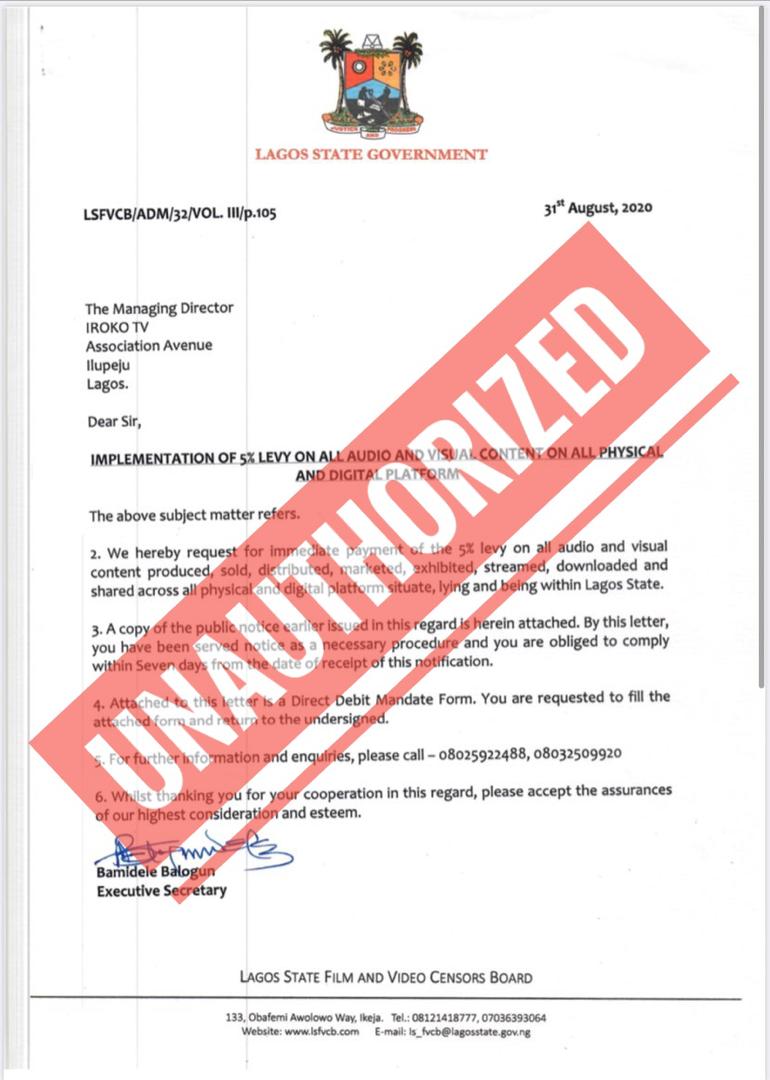
The Board had even gone ahead to issue a 7-day ultimatum to Lagos-based online streaming platform, iROKOtv, to comply with the directive.


In the notice, dated August 31 and addressed to iROKOtv’s Managing Director, Jason Njoku, which he shared via twitter, the LSFVCB had requested “the payment of the five percent levy on all audio and visual contents produced, sold, distributed, marketed, exhibited, streamed, downloaded and shared across all physical and digital platform situate lying and being within Lagos State.”


The notice which was signed by the board’s Executive Secretary, Bamidele Balogun stated that: “By this letter, you have been served notice as a necessary procedure and you are obliged to comply within seven days from the due of receipt of this notification.”
Also attached to the letter was a direct debit form, mandating the company to fill the form.
TCN had also reliably gathered that the levy would also be imposed on YouTube but may not be extended to Netflix for now “because its operation has not gained ground much in Nigeria”.
However, the Board’s action had justifiably angered the creative industry who had hoped that the intervention of the Director General of the National Film and Video Censors Board to halt the implementation in order for wider consultations to be carried out, was ignored by Bakogun.
“What is this joke?!”, Nigerian rapper and actor, Folarin Falana a.k.a Falz, wrote on his Instagram handle while reacting to Njoku’s letter.
Filmmaker Moses Inwang also described the move as a form of exploitation.
“A government that has rendered zero support to the creative industry wants to take 5% from their proceeds, AFTER OTHER TAXATIONS! Okay o!” Inwang commented.
Also, TV Host and Model, Sammy Walsh, said: “must be crazy! It’s too [to] create in a diff [different] state and come back…”
“Film and Video Censors Board!! Lol! You are being censored alright! Juxtapose this with the incentives and tax breaks @Tesla and @Amazon received in a bid to attract them to site their facilities in certain States in the US and I regretfully announce…” a twitter user, @naijacodes opined.
Similarly, the Audiovisual Rights Society of Nigeria (AVRS), through a press release made available to TCN, directed “all organizations in Nigeria, deploying audiovisual works belonging to AVRS members to immediately obtain an AVRS license for distribution, exhibition and public performance of audio visual, works in Nigeria or face attendant litigation.”
While reacting to the 5% levy implementation letter reportedly being circulated to all audiovisual outlets in Lagos, AVRS chairman, Mahmood Ali-Balogun advised the affected outlets to seek legal advice before complying with the directive, adding that “members of AVRS have not authorized any entity to license works belonging to AVRS members and collect royalties therefrom.”
Lawyers to AVRS have also advised the organisation that LSFVCB’s move to levy the production, sale and distribution of audio visual content is illegal.
“We have the instructions of Audio Visual Rights Society of Nigeria Ltd/Gte (AVRS) to issue this public statement, advising all its members, producers, distributors, marketers and all commercial and public users of Audio Visual content across all media, including physical and digital platforms, that the attempt by Lagos State Film and Video Censors Board (LSFVCB) to levy the production, sale and distribution of audio visual content is illegal,” Creative Legal said in a public statement issued on behalf of AVRS.
In conclusion, the statement said: “The Law does not permit LSFVCB to issue levies for the performance of any function by anyone else, including the production, sale and distribution of audio visual content, as is now being unlawfully attempted. As the Federal Government approved Collective Management Organization for audio visual works, ONLY AVRS may issue and collect “levies,” and royalties for the distribution, exhibition and public performance of audio visual works – FOR THE BENEFIT OF RIGHT OWNERS.”
Recall that TCN had reported in August that stakeholders in the creative industry rejected the introduction of the levy, arguing that it amounts to multiple taxation on content owners at a time that government ought to provide visible palliative for a sector that is already in dire straits.
The directive by the Lagos State Government on Friday evening to suspend Balogun while dissiciating itself from the said levy may have therefore put an end to this seemingly exploitative policy.