
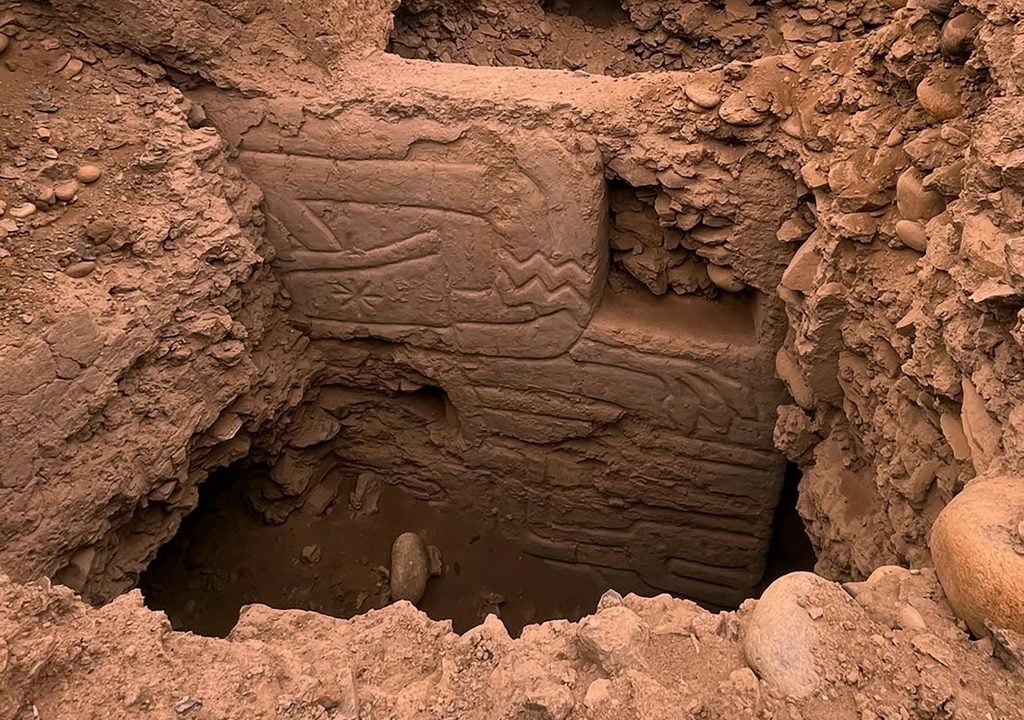
Archaeologists in Peru have uncovered a more than 3,000-year-old mural with a three-dimensional design, indicating a sophistication and artistry that is without precedent for pre-Inca cultures in the region.
Spanning 13-by-five feet, the polychrome mural was discovered at Huaca Yolanda, a site 500 miles north of the capital Lima. It was built by a little-known culture that emerged during a period when groups in the country’s northern coastal valleys were developing increasingly complex social structures and architectures.




An aerial view of the site at Huaca Yolanda where archaeologists found the mural. Photo: courtesy PUCP.
The mural, which is double-sided and was likely the inner wall of a temple atrium, was made out of clay mixed with organic materials. It depicts stars, marine plants, and fish-like figures in carved relief with traces of blue, yellow, and black paint still visible in some places. The mural’s central character is a large fish figure whose body appears as a three-dimensional net. Its remarkable state of preservation was down to having been buried to allow for another structure to be built on top, a fairly common practice among pre-Incan civilizations.
The excavation was undertaken by researchers from Pontifical Catholic University of Peru and the National University of Trujillo as part of a decade-long project to investigate sites in in northern Peru’s Chao and Santa Valleys.

The polychrome mural found at Huaca Yolanda. Photo courtesy PUCP.
“This mural at Huaca Yolanda is unique, nothing like it has ever been recorded in the area,” Ana Cecilia Mauricio, who has led the project since 2012, said in a statement. “Based on the design and decoration style of this mural, it is between 3,000 and 4,000 years old.”
This dating places it among the earliest discovered examples of large-scale temple decoration anywhere in the Americas. Its thematics of water and sky suggest strong spiritual connections to the sea and the cosmos, which echo the belief systems of the later Moche and Chavin cultures. In addition to continuing excavations in the hope of finding more murals and potentially artifacts that can help to better understand the site, the mural is set to undergo radiocarbon dating and pigment analysis.

Archaeologists excavating the polychrome mural at Huaca Yolanda. Photo courtesy PUCP.
Despite the excitement surrounding the discovery, the researchers stressed that the site is at risk from environmental factors, agricultural expansion, and looting. In fact, the mural was partly found by following a hole that had been made by looters. Furthermore, shifting rain patterns and unregulated agricultural expansion are threatening this and other sides.
“Heavy machinery, such as tractors, used for farming is seriously damaging the Huaca Yolanda,” Mauricio said. “We need the Ministry of Culture, as well as regional and municipal authorities, to act urgently to protect this heritage.”
Credit: Art Net