
Following the release of the trailer for Netflix’s new series “Queen Cleopatra,” produced by Jada Pinkett Smith, wife of Will Smith, a petition to cancel the show has gained significant traction online. Over 60,000 people have already signed the petition, which calls for the cancellation of the show due to concerns surrounding historical inaccuracies and cultural appropriation.
Critics argue that the series, which chronicles the life of the last pharaoh of ancient Egypt, Cleopatra VII, is riddled with historical inaccuracies that perpetuate misconceptions about the real origin of the Queen. The contentious series has spurred heated discussions on social media about historical revisionism, racism, supremacism, and ethnicity. Additionally, concerns have been raised about the casting of the main character, with some arguing that the actress chosen to play Cleopatra is not representative of the historical figure’s ethnicity.


Maha Shehata and Aikk Yasser organized the petition to halt the upcoming documentary because it was “falsifying history.” The creators of the petition claim that Egyptians who believed that Egyptian history was being misrepresented were responsible for its creation.


A group’s desire to claim Egypt’s history and deprive the true Egyptians of it is being pushed via the pseudoscience known as “afrocentrism.” They are still trying to fabricate history using fraudulent articles and no supporting proof, according to the petition’s opening statement.

Casualty star Adele James will star as Cleopatra, while EastEnders’ John Partridge will play Julius Caesar, The Last Kingdom’s Craig Russell will play Marc Antony and former EastEnders’ actor Michael Greco will star as Pothinus.
Netflix has yet to issue an official response to the petition and the show is still set to premiere in the upcoming weeks. The controversy surrounding the show highlights the ongoing debate around the importance of historical accuracy and cultural representation in film and television productions. It remains to be seen whether Netflix will address these concerns or if the backlash will have any impact on the show’s release.
Controversy and Representation: The Debate Over Queen Cleopatra’s Portrayal
The debate surrounding the portrayal of Queen Cleopatra in Netflix’s new series has sparked significant discussion on social media platforms. Central to the debate is the question of whether Cleopatra should be portrayed as a black queen or if another representation is more historically accurate.
Cleopatra VII, the last pharaoh of ancient Egypt, was a member of the Ptolemaic dynasty, which descended from Ptolemy I, a Macedonian Greek general who served under Alexander the Great. As a result, some argue that Cleopatra’s ancestry was primarily Greek, and thus, she should not be portrayed as a black queen.
Others, however, assert that presenting Cleopatra as a black queen could contribute to a more inclusive and diverse representation of historical figures in film and television.
The debate on social media has led to a wide range of opinions, with some users advocating for more historically accurate portrayals and others stressing the importance of diverse representation in media. As with any historical figure, it can be challenging to determine the exact appearance of Cleopatra, which leaves room for interpretation and artistic license. The conversation surrounding the representation of Queen Cleopatra highlights the complexities of portraying historical figures in modern media and raises questions about the responsibilities of filmmakers and producers when depicting history.
“African Roots of Ancient Egypt”: Exploring the Afrocentric Perspective on Egypt’s History
Afrocentrism is a cultural and historical perspective that emphasizes the importance of African history and the contributions of African people to global civilization. When applied to the study of ancient Egypt, the afrocentric view focuses on the idea that ancient Egyptian civilization was fundamentally African in nature, with its people, culture, and achievements rooted in the African continent.
Proponents of the afrocentric view argue that the ancient Egyptians were indigenous to Africa and that their culture and society shared many similarities with other African cultures. They highlight the geographical location of Egypt on the African continent and the evidence of cultural connections with neighboring African civilizations.
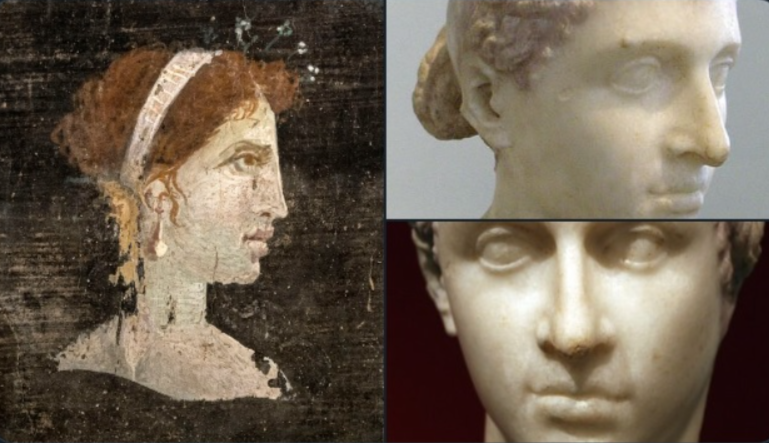
Representations of Cleopatra both in Hellenistic and Roman art.
Afrocentrists often challenge the traditional Eurocentric perspective, which has historically emphasized the connections between ancient Egypt and Mediterranean or Near Eastern civilizations, sometimes to the point of downplaying or even denying its African roots. They assert that such Eurocentric interpretations can be biased and contribute to the marginalization of African history and achievements.
Key points of the afrocentric view of ancient Egypt’s history include:
Racial and ethnic identity: Afrocentrists argue that ancient Egyptians were primarily black or African in origin, rather than belonging to a more Mediterranean or Middle Eastern racial group. They base this argument on various sources, such as physical anthropology, artistic representations, and historical records.
Cultural connections: Afrocentrists emphasize the shared cultural practices and beliefs between ancient Egypt and other African civilizations. They point to elements such as religious beliefs, social structure, and artistic styles as evidence of these connections.
Contributions to global civilization: The Afrocentric view highlights the significant achievements and advancements of ancient Egyptian civilization, asserting that these contributions have often been downplayed or overlooked due to Eurocentric biases.
Reclaiming African history: Afrocentrism seeks to challenge and rewrite the often Eurocentric narratives of history, giving due credit and recognition to the role of African civilizations, including ancient Egypt, in shaping world history.
were there ever black pharaohs?: Exploring the 25th Dynasty of The Nubian Pharaohs and its African Roots
Ancient Egypt was in many cases, a complex, diverse society with many different dynasties throughout its history. While it’s relatively easy to determine the precise racial or ethnic backgrounds of most of Egypt’s ancient rulers, some dynasties were more closely connected to the African continent, and their pharaohs may have been of African descent.
One of the most notable examples is the 25th Dynasty, also known as the Nubian or Kushite Dynasty, which ruled Egypt from around 747 to 656 BCE. This dynasty originated from the Kingdom of Kush, located in present-day Sudan, south of Egypt. The Kushite pharaohs were of African descent and shared cultural ties with other African civilizations.
Some of the most famous pharaohs of the 25th Dynasty include:

Head of Taharka
Piye (Piankhi): The first Kushite pharaoh who conquered Egypt and founded the 25th Dynasty. Piye ruled both Egypt and Kush, establishing a significant empire that spanned from the Nile Delta to present-day Sudan.
Shabaka: Piye’s successor and the second pharaoh of the 25th Dynasty, Shabaka further expanded the empire and left a lasting impact on Egyptian art, culture, and religion.
Taharqa: One of the most famous Kushite pharaohs, Taharqa ruled during the height of the 25th Dynasty’s power. He was involved in several military campaigns and played a significant role in the geopolitics of the ancient Near East.
Tantamani: The last pharaoh of the 25th Dynasty, Tantamani tried to regain control over Egypt after Assyrian invasions but was ultimately defeated.
It is important to remember that ancient Egypt was a melting pot of various cultures and ethnicities. The pharaohs of different dynasties, including those of the 25th Dynasty, were part of this complex and diverse society. While some pharaohs may have had African ancestry, they also shared connections with other civilizations and cultures throughout Egypt’s long history.
Understanding and Challenging Supremacist Ideologies: Beyond Black African and white Supremacy
Black African supremacy, much like white supremacy, refers to the belief that people of African descent are superior to other racial and ethnic groups. It is important to note that this belief is not representative of the majority of people of African descent, but rather a fringe ideology held by a small number of individuals.
The concept of black African supremacy may be rooted in reactions to historical injustices and racial discrimination, including slavery, colonialism, and ongoing social inequalities. Some proponents of black African supremacy may use this belief system as a way to counterbalance the effects of white supremacy and Eurocentric historical narratives, which have often marginalized African history and achievements.
It is crucial to distinguish between black African supremacy and other movements, such as Pan-Africanism, which seek to celebrate African heritage, promote unity among people of African descent, and challenge Eurocentric historical perspectives. These movements generally do not promote the superiority of one racial or ethnic group over others but instead focus on empowerment, cultural pride, and historical accuracy.
In the pursuit of racial equality and justice, it is essential to recognize and challenge supremacist beliefs, whether they promote the superiority of one racial or ethnic group over another. Efforts should be made to promote understanding, tolerance, and respect among people of diverse backgrounds and to foster a more inclusive and equitable society.