

The Native American galleries of the Speed Museum display objects like artifacts from various tribes across the country. They also highlight contemporary artists.
At the entrance of the Speed Museum’s newly revamped Native American galleries, a glass case stands tall against a wall with a poem by Layli Long Soldier of the Oglala Lakota Nation.
Inside the case is a small structure that once propped up an object from the Cheyenne and Arapaho nation in Oklahoma. It’s deliberately displayed to convey the absence of the object, once a “crowd favorite” at the galleries, museum leaders said.


That’s where a cradleboard, traditionally used to carry babies and passed down through generations of Native American mothers, previously stood for public viewing. The tool is what the federal government classifies as an object of patrimony. It doesn’t have a specific owner, and the museum received it in 1937. And under new federal guidelines, the Speed can’t show it without the consent of tribes it could be traced back to.



When fari nzinga, the Speed’s curator of African and Native American collections began conversations with tribes to identify objects and art, Cheyenne and Arapaho nation representatives asked about the cradleboard. It’s not currently on display.
“Because while we do have it in our collection, and it is an excellent example of beautiful bead work and collective art-making and ancestral art practice, we are trying to make sure that we’re on the right side of the law,” nzinga said.
She said if and when the Cheyenne and Arapaho tribal representatives decide that they would like to claim the cradleboard, the museum would be ready to respond.
The U.S. Department of the Interior’s update to NAGPRA, the Native American Graves Protection and Repatriation Act, went into effect on Jan. 12.
That law was enacted in 1990.
nzinga and curatorial intern Sirene Martin said the update came in the middle of their work on relaunching the galleries.
The new federal regulations now require museums to get free, prior and informed consent from Native tribes before displaying objects of cultural significance. They also require tribal consent before museums can conduct research or loan the objects.
The rules apply to funerary articles from burial sites, sacred items connected to religious practice and objects of cultural patrimony — meaning those that collectively belong to a tribe, community or family, like the cradleboard or ancestral remains.
nzinga said conversations with tribes began late last summer, when they reached out to over 200 tribes with a “wide open invitation” to consult with the Speed on various NAGPRA-eligible objects the museum had in its collection.
“In that time, we have maintained close correspondence with about 50 of them as we tried to narrow down who is affiliated with the objects,” said curatorial intern Sirene Martin, who is part of nzinga’s team.
According to the Speed, the previous installation of the Native American Art Galleries had 72 objects on view. The 2024 reinstalled galleries have 39. Officials with the Speed did not provide a response to questions about whether they still need to get consent for the pieces that aren’t on display.
Asked how the museum knew to follow the 2024 guidelines when they started the work the year before, museum director Raphaela Platow told LPM News they were “ahead of the curve.” She said they did not receive any advance notice of the rule changes.
nzinga said she also reached out to Native American curators to put together a Native American advisory council, which she said helped to shape her thinking and interpretation of the objects and art in the Speed’s possession.
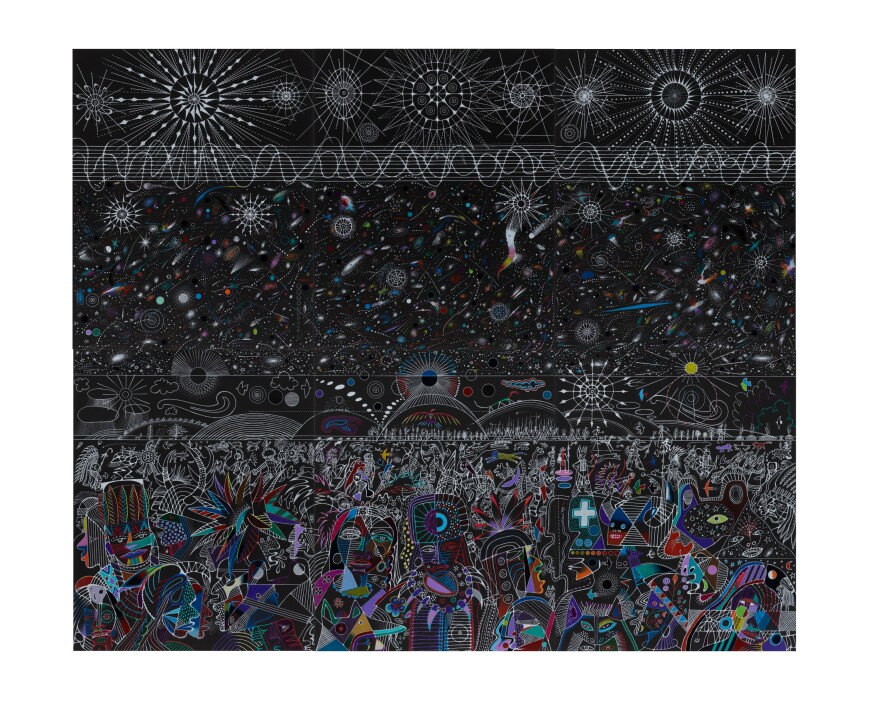
She said she wanted to acquire contemporary work by Native American artists and move beyond just artifacts and objects, because she felt it was insinuating there weren’t Native Americans making work and doing innovative things today.
“We felt we really wanted to mix it up and add more contemporary work alongside more historical material,” she said.
Meranda Roberts is on the Speed’s Native American advisory council . She said she wants to get people to see Native American culture from a first-person perspective, rather than an outsider’s interpretation.
Roberts is a Chicana citizen of the Yerington Paiute Tribe and is a curator consulting on anti-colonial practices for museums and institutions.
“The work I do is very much based in trying to get back to people realizing ‘How do they learn about us to begin with?’” she said.
The work toward NAGPRA compliance
After the recent update to the NAGPRA guidelines, museums including the American Museum of Natural History in New York City closed some Native American exhibits to review the pieces in them for compliance.
Roberts said museums and institutions are probably being over-cautious right now. “But I think that it’s also understanding and having to take a step back and realize, ‘How did our practices contribute to this mess? How do we fix the problems that have contributed to this confusion so we can clear it up?’” she said.
Working with museums and institutions requires a lot of patience and trying different approaches, Roberts said.
“The people who collected these pieces never anticipated us coming back for them…that wasn’t a part of their agenda when they created these museums and we are here,” she said. “So there is no roadmap to being perfect.”

When a tribe receives a request for consultation from a museum or institution, representatives usually have to physically go to where the objects are to verify them, potentially across the country.
That was the case for the Shawnee Tribe, whose leader said they are in active communication with the University of Kentucky on efforts to repatriate human remains. According to a ProPublica database, UK has one of the largest collections of Native American human remains in the country.
Shawnee Tribe Chief Ben Barnes said he’s happy about the change to guidelines, but thinks they will be challenging for tribal nations having to deal with universities as well as public and private museums. Paying for those trips, and the work done on them, could be a barrier.
“Having said that, our inboxes aren’t being flooded by people reaching out to the tribe,” he said.
Barnes said institutions may find it difficult to determine which tribe to contact about particular collections because a lot of them are “unassociated,” especially in the case of ancestral remains.
“There’s not enough money to do all this. And to have to write a grant and get the grant approval through a federal process, that takes time. And there’s a limited amount of funds,” he said.
The new guidelines require institutions to reach out to tribes, update their inventories and publish that information in the Federal Register within five years, which Barnes predicts will be a difficult undertaking.
“If we don’t have consultations established, if they’re not requesting consultations, you know, we can’t go out and find everybody. That is impossible. So the onus is on them,” Barnes said.
Right now, the Speed Museum has ancestral remains in its collection, and has not repatriated them.
“The Speed is actively conducting provenance research to determine the circumstances in which they arrived as part of the museum’s repatriation efforts, and is in active communication with two different tribes,” according to an emailed statement from the museum.
The Speed Museum provides financial support to Louisville Public Media.