
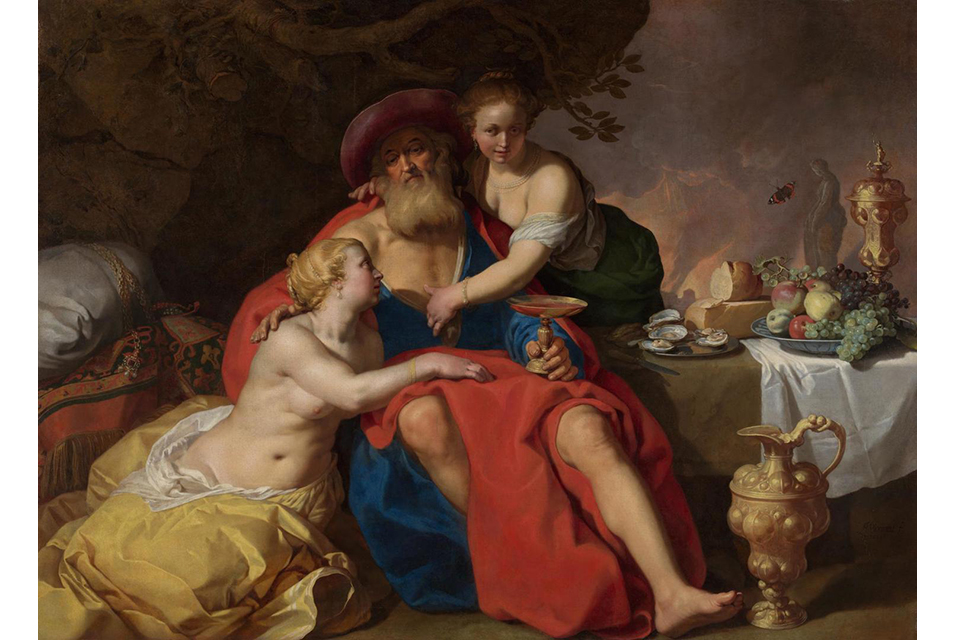
The National Gallery has announced that it has acquired the painting Lot and his Daughters (1624) by Abraham Bloemaert (1566–1651), which has been on loan to the Gallery for the past four years from a private collection. This is the first painting by the artist to enter the National Gallery Collection. The painting is on display in Room 24 from today (Tuesday 19 December).
The painting’s subject is the Old Testament story of Lot and his daughters, popular because of its moralising potential and dramatic possibilities. The story (Genesis 19) recounts how Lot was spared on account of his virtue and escaped God’s destruction of the immoral city of Sodom with his wife and two daughters. After the loss of his wife, who was turned to salt for disobeying God’s command not to look back at the burning city, Lot eventually settled inside a cave with his daughters. Lot’s two daughters believed only they remained alive on earth and took the desperate measure of seducing their own father to ensure the continuation of the human race. Nine months later, the sisters bore the sons Moab and Ben-Ammi, founders of the Moabite and Ammonite tribes. From the Moabite tribe eventually emerged Ruth, who, according to some theologians, was the ancestress of Christ.
Already in the Middle Ages, depictions of this biblical story served to moralise on the danger of female seduction and the unfavourable effects of alcohol. Abraham Bloemaert drew inspiration from paintings on the same subject by both Lucas van Leyden (about1494–1533) and Hendrick Goltzius (1558–1617). But Bloemaert also altered the narrative thrust of their scenes, portraying Lot and his daughters as mostly clothed and psychologically disconnected from one another, rather than nudes engaging in a range of carnal pleasures. This had the effect of emphasising the moral dilemma of this story to the viewer.
Lot looks hazily to the ground, seemingly unaware of the unsteady drinking cup he holds in his hand. A shadow cast by his wide-brimmed hat falls over his eyes, symbolic of his disengagement and obliviousness to the intentions of his daughters. In the background we see how the city of Sodom is burning, while the fate of Lot’s wife is also visualised. The symbolically charged items forming the still life provide a commentary on the moral and ethical issues surrounding this biblical narrative.
‘Lot and his Daughters’ was only recently recognised as a work by Abraham Bloemaert. Around the beginning of the 20th century it was attributed to Peter Paul Rubens (1577–1640) on the basis of a false signature applied in the 19th century. Throughout most of the 20th century it was ascribed to Jacob Jordaens (1593–1678) and, when it was sold in 2004, it was attributed to Abraham Bloemaert’s son Hendrick (1601/2–72). With the discovery of Abraham Bloemaert’s signature and date during the painting’s restoration in 2004, it became possible to identify this work as the ‘grand gallery picture’ auctioned on 14 February 1811 in London, which, according to the sale catalogue, had belonged to King Charles II of England (1630–85).
The painting is a fine example of a work painted at the height of Bloemaert’s artistic maturity, when he was in his late fifties but keeping up with the latest trends in painting with the gusto of a budding young artist. Indeed, the painting is indebted to the work of Bloemaert’s pupils, notably that of Gerrit van Honthorst of the 1620s.
Bart Cornelis, Curator of Dutch and Flemish Paintings 1600–1800 at the National Gallery, says: ‘Bloemaert was among the most influential artists of the Dutch Golden Age, but his work was not represented at the National Gallery. This acquisition therefore fills a significant gap in the collection with one of the artist’s most arresting paintings, its powerful triangular composition brimming with primary colours and beautifully painted still-life details.’
Born on Christmas Eve in 1566 in Gorinchem, Abraham Bloemaert came from a family with artistic ties. His father was the Catholic sculptor and architect Cornelis I Bloemaert (about1540–1593). Abraham’s early education included copying the works of the Antwerp master Frans Floris.
After spending some time in Paris, Bloemaert returned to Utrecht in 1585, where he initially worked with his father. He later moved to Amsterdam and gained recognition as a painter. His work found its way into esteemed collections, and he became known for paintings such as ‘The Death of the Children of Niobe’ (1591, Statens Museum for Kunst, Copenhagen) and ‘The Wedding of Peleus and Thetis’ (about 1595, Alte Pinakothek, Munich), whose Mannerist approach betrays the influence of Bartholomaeus Spranger. In 1593 Bloemaert returned to Utrecht, where he would spend the rest of his life and where for many years he was the leading painter and an outstanding teacher. Jan Both, Gerrit van Honthorst, Hendrick ter Brugghen (represented at the Gallery with important works), and many other Utrecht painters of the period who attained any kind of distinction trained with him. His four artist sons also learned their trade from their father. Bloemaert was a good learner too and rapidly assimilated the new ideas his pupils brought back from Italy.
Bloemaert’s style evolved over time. Early in his career he was one of the leading Dutch exponents of Mannerism, but around 1610 his style shifted from Mannerism to a more classicising approach. In the 1620s he had a Caravaggesque phase, and in his later years he adopted some aspects of the classicism of the Carracci. Bloemaert’s reputation extended beyond Utrecht. He received commissions for high altars and devotional works in various cities, and his talent was recognised by the stadtholder’s court. Notable visitors to his studio included Peter Paul Rubens and Elizabeth Stuart. In his later years, Bloemaert focused on creating a teaching manual which was published by his son Frederick in 1650 under the title ‘Artes Apellae Liber’ and later as ‘De Teeken-const’. Abraham Bloemaert died in 1651 at the age of 86.


Credit: https://artdaily.cc/