
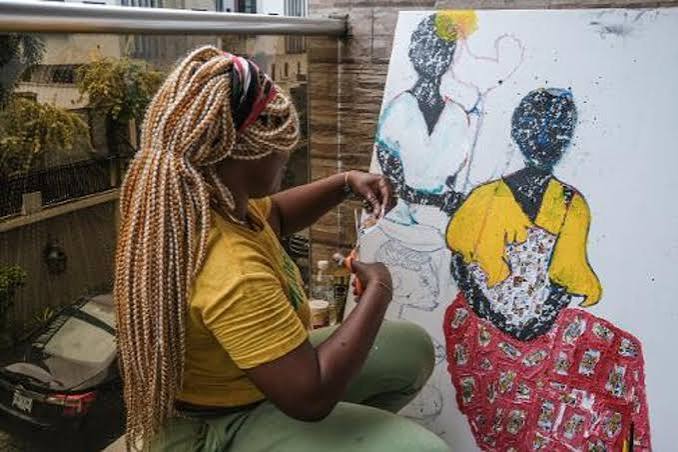
Kokopelli Art Foundation has concluded its first artist residency, Once Upon a Time (O.U.T): Our Story First, a two‑week, Lagos‑based programme that brought together five emerging artists from Ethiopia, Ghana, Benin Republic and Nigeria, and will culminate in a fifth‑anniversary exhibition, Epignosis I: Our Story First, opening to the public on 12 September 2026.
The residency ran from 24 August to 6 September in Ikoyi, with eight facilitators and five senior “flash mentors” supporting the cohort to produce one resolved work each for the show, which runs until 8 November at Kokopelli Gallery, 17 Ademola Street, Ikoyi, Lagos.
Convened by the non‑commercial arm of Kokopelli Gallery, O.U.T is structured around three axes: Mind (critique and argument), Body (studio work and field research across Lagos) and Soul (communal living and mentorship). The premise, as stated in the curatorial note, is that “the first account of a people should be given by that people”; the theme is therefore the condition under which the work is made, not its prescribed content.
Dare Herald, director of Kokopelli, said the initiative responds to a long‑standing distortion of African narratives by outsiders and to market pressures that distract artists from deeper storytelling. “We believe that Africa has a lot of stories to last generations. But over the years, a lot of our artists seem to be distracted because of many factors. It could be because that’s where they live; because it’s the trend of things to be; because that’s what the collectors want to buy, or something like that. But we know that we need to tell our stories by ourselves,” he said. “As a matter of fact, in recent times, we’ve seen situations where foreigners tried to tell our stories for us. In the process of doing that they mix things up. So we know that it’s best most times for us to tell our stories by ourselves so that we don’t lose context.”
He said because of this there are now African artists who are conscious and very intentional about the African story. He said for the program, there are 8 facilitators and 5 flash mentors.
The residency’s instructional core comprised eight facilitators covering practice sustainability, artistic voice, materials and methods, iconography, research, copywriting and artist statements, legal protection (copyright and contracts), and personal branding: Qudus Onikeku (Sustaining the Practice), Seun Alli (African Artist’s Signature and Unique Voice), Ato Arinze (Materials and Methods), Prof. Abiodun Akande (Iconography), Victor Ehikhamenor (Research Methods), Belinda Doubara Yanga (Writing Your Practice: Copywriting and Artist Statements), Titilope Mustapha (Legal: Copyright, Contracts and Protecting Your Practice), and Taiwo Adeyemi (Personal Branding for Artists).
They were joined by five “flash mentors” — Duke Asidere, Ayoola Gbolahan, Akinbode Adebiyi, Kelani Abass and Juliet Ezenwa — who each hosted a resident for a concentrated, one‑day apprenticeship in their working studios.
Herald framed this as a deliberate revival of a dying culture of post‑school apprenticeship in the visual arts: “We believe that the culture of apprenticeship in Arts is dying. Before, when an Artist finishes from school, they look to position themselves to a master, an established artists who gives them some rudiments of the art, put them on a better foundation. This was life after school. That’s how it was done. But unfortunately, that culture is dying. So we have to factor into the system and the structure of this residences that every year, our residence participants take in at least an established artist for one day. So, basically, that’s the structure of the residency. It is supposed to be an experimental phase, because this is the first time we’re doing it, but I think so far it’s been going so well.”
Selected from hundreds of applications, the inaugural cohort — who will become the foundation’s first alumni, the OUTliers — spans painting, printmaking, installation and photography, with practices oriented to social critique, identity, environment and the politics of representation. The selection criteria emphasised two to five years of experience and a clear sense of self‑identity. “We were looking for two to five years of experience. We had over 400 applications, those 500, but a lot of them were taken off because they were like 5 to 10 years of experience,” Herald said. “Secondly, we were looking for people who had inclinations. You know, self-identity.”
The five resident artists of Edition 1 are:
Estifanos Solomon Gashaw (Ethiopia). He works in painting and printmaking. His practice confronts the failure of society to protect its most vulnerable, and children in particular, in a world shaped by individualism, consumerism and instant gratification. He treats making as a form of resistance against apathy, injustice and systems that place profit and ego above empathy and care. Drawing on stories from his community and from the media, his work exposes the quiet and often unseen harm caused by neglect, both personal and institutional. Each piece asks a single question: whether we are supporting the next generation, or are complicit in the erosion of its potential.
Asked about his focus, Gashaw said: “My work focuses on social issues.”
Victor Anachuna (Nigeria) is a Nigerian contemporary painter whose work explores how individuals navigate systems of power, social hierarchy and political instability. Working in realism, he depicts Black figures in compositions informed by the visual language of the Renaissance, using dramatic lighting, controlled gesture and layered symbolism to stage scenes in which composure coexists with conflict. His practice moves between scales: intimate works centred on gestures of tenderness and solidarity that challenge narrow expectations of Black identity and masculinity, and larger compositions such as the triptych Predator. Prey. Protest., where figures gather, flee or confront one another in spaces that enforce division and control. He said: “My work focuses on identity.”
Putin Bempong (Ghana) works in painting and installation, at the intersections of folklore, environmental transformation, material experimentation and speculative futures. Research forms the foundation of his process, and he works with unconventional materials gathered during field research, including contaminated water, mining soil, preserved organic matter, phototransfers, industrial paint, resin and found objects. These carry their own histories, allowing the work to function as both image and archive.
The Akan trickster Ananse recurs throughout Bempong’s practice as a figure of adaptation, intelligence and survival, through which he questions power, environmental exploitation and the narratives societies construct about progress. He said his work is about “the connection between humans and the environment.”
On the residency experience, Bempong said: “In my case, coming down here is very important. It has been an amazing experience — meeting new people, and learning from facilitators. Coming to Nigeria and visiting places like the Old Secretariat and house which have similar architectures with Ghana will be so helpful to my research. This is because Ghana and Nigeria have similar culture and similar ideas. Buildings have history because they’ve seen migration. So it has really helped me.”
Falhone Kemi Ogoun (Benin Republic) was born in Porto Novo, Benin Republic, and is a self taught artist working across drawing, painting and installation. Her practice explores the tensions between appearance and essence, surface and depth, and places the natural world at the centre of its reflection. An heir to Yoruba and Nago cultures, she returns continually to the portrait. The face interests her not as anatomical surface but as territory, the place where a person’s character and inner beauty are decided, in keeping with a Yoruba philosophy that values ethics, conduct and a benevolent soul.
Each of Ogoun’s work becomes a space where tradition and contemporaneity meet. On the residency, she said: “I find this experience important because it’s going to change a lot of things in my artistic practice. It’s my first time. I see that here, people take art really, seriously. Back home, it isn’t like that. The way we are treated; the way we are stimulated so that we can produce — I like that a great deal. We were taught to be responsible, to defend our race, to tell our own stories. Well, it is like that elsewhere, but the seriousness that’s put in here, it isn’t like that elsewhere. It puts me under pressure. I find that that’s a good thing. It makes me take my work more seriously.”
Vurzie Kimnaton (Nigeria) is a fine art photographer who has spent most of her life in Northern Nigeria, photographing its changing seasons, markets, festivals and the people who move through them. Her work is built on duration and attention, on the routines, gestures and encounters that reveal a place slowly. Lagos remains unfamiliar to her, and that is precisely the draw. During the residency she is walking the city with her camera, returning to the same markets, neighbourhoods, bus stops and waterfronts, asking what residents have stopped seeing because it has become ordinary, and what those same scenes reveal to someone encountering them for the first time. She said: “This residency is my first residency. I am a fine art photographer. It’s easy for people to say, okay, you can just carry your camera, go out and get some pictures. For me, it has opened my mind in different ways. I’ve had to sit down with myself and think deeper on how I can tell stories that are impactful. So, going through this process, I would say it’s challenging because that’s why I applied for the residency. I was looking for something to challenge me, to help me in my practice. Right now, I don’t know what my final work is going to be, but I also look forward to it. But I know I am going to create something incredible and look forward to it.” She said her work is mainly about capturing the essence of people.
The residency’s output feeds directly into Epignosis I: Our Story First, framed as a “Call and Response” exhibition and the centrepiece of Kokopelli Gallery’s fifth anniversary. “Epignosis” here denotes a story that changes you; the show pairs a solo body of work by senior artist Ayoola Gbolahan with the five new works made during the residency. The “call and response” structure, drawn from African oral and musical traditions, is deliberate: one voice speaks, another answers, and the answer shifts the meaning of what came first. This is not a senior artist exhibiting with students; it is two generations in one room, on the same terms, with everything made in the two weeks conceived specifically “for that room.”
The exhibition schedule is: private dinner on Thursday, 10 September 2026; private view on Friday, 11 September 2026; public opening on Saturday, 12 September 2026; running till 8 November 2026. Venue: Kokopelli Gallery, 17 Ademola Street, off Awolowo Road, Ikoyi, Lagos.
Kokopelli Gallery is a contemporary art gallery devoted to artists for whom storytelling is a discipline, a form of knowledge rather than ornament. Founded in Lagos in 2021, its programme platforms artists and griots whose narratives cross conventional borders, sustaining a culture of dialogue and memory. This conviction takes physical form in the Grotto, the gallery’s immersive space, conceived as a literal roomful of stories. It extends through exhibitions and the Tales and Cocktails series, and now through the OUT Residency, the gallery’s newest and most considered undertaking, whose graduates carry the name Outliers. The gallery marks its fifth anniversary in September 2026.
Partners and patrons supporting the initiative include The Igiehon Museum Project, Qoray Mobility through Cabzero, Macallan, Rujo and Dala.
Beyond the anniversary framing, the programme signals a shift in infrastructure: a Nigerian gallery funding a cross‑border residency that emphasises mentorship, legal and branding literacy, and a culture of apprenticeship often absent after formal training. By requiring one resolved work rather than a portfolio, and by exhibiting residents alongside an established artist without hierarchical framing, Kokopelli is testing a model where infrastructure, not just talent, produces a generation.
Credit: Vanguard
The residency ran from 24 August to 6 September in Ikoyi, with eight facilitators and five senior “flash mentors” supporting the cohort to produce one resolved work each for the show, which runs until 8 November at Kokopelli Gallery, 17 Ademola Street, Ikoyi, Lagos.
Convened by the non‑commercial arm of Kokopelli Gallery, O.U.T is structured around three axes: Mind (critique and argument), Body (studio work and field research across Lagos) and Soul (communal living and mentorship). The premise, as stated in the curatorial note, is that “the first account of a people should be given by that people”; the theme is therefore the condition under which the work is made, not its prescribed content.
Dare Herald, director of Kokopelli, said the initiative responds to a long‑standing distortion of African narratives by outsiders and to market pressures that distract artists from deeper storytelling. “We believe that Africa has a lot of stories to last generations. But over the years, a lot of our artists seem to be distracted because of many factors. It could be because that’s where they live; because it’s the trend of things to be; because that’s what the collectors want to buy, or something like that. But we know that we need to tell our stories by ourselves,” he said. “As a matter of fact, in recent times, we’ve seen situations where foreigners tried to tell our stories for us. In the process of doing that they mix things up. So we know that it’s best most times for us to tell our stories by ourselves so that we don’t lose context.”
He said because of this there are now African artists who are conscious and very intentional about the African story. He said for the program, there are 8 facilitators and 5 flash mentors.
The residency’s instructional core comprised eight facilitators covering practice sustainability, artistic voice, materials and methods, iconography, research, copywriting and artist statements, legal protection (copyright and contracts), and personal branding: Qudus Onikeku (Sustaining the Practice), Seun Alli (African Artist’s Signature and Unique Voice), Ato Arinze (Materials and Methods), Prof. Abiodun Akande (Iconography), Victor Ehikhamenor (Research Methods), Belinda Doubara Yanga (Writing Your Practice: Copywriting and Artist Statements), Titilope Mustapha (Legal: Copyright, Contracts and Protecting Your Practice), and Taiwo Adeyemi (Personal Branding for Artists).
They were joined by five “flash mentors” — Duke Asidere, Ayoola Gbolahan, Akinbode Adebiyi, Kelani Abass and Juliet Ezenwa — who each hosted a resident for a concentrated, one‑day apprenticeship in their working studios.
Herald framed this as a deliberate revival of a dying culture of post‑school apprenticeship in the visual arts: “We believe that the culture of apprenticeship in Arts is dying. Before, when an Artist finishes from school, they look to position themselves to a master, an established artists who gives them some rudiments of the art, put them on a better foundation. This was life after school. That’s how it was done. But unfortunately, that culture is dying. So we have to factor into the system and the structure of this residences that every year, our residence participants take in at least an established artist for one day. So, basically, that’s the structure of the residency. It is supposed to be an experimental phase, because this is the first time we’re doing it, but I think so far it’s been going so well.”
Selected from hundreds of applications, the inaugural cohort — who will become the foundation’s first alumni, the OUTliers — spans painting, printmaking, installation and photography, with practices oriented to social critique, identity, environment and the politics of representation. The selection criteria emphasised two to five years of experience and a clear sense of self‑identity. “We were looking for two to five years of experience. We had over 400 applications, those 500, but a lot of them were taken off because they were like 5 to 10 years of experience,” Herald said. “Secondly, we were looking for people who had inclinations. You know, self-identity.”
The five resident artists of Edition 1 are:
Estifanos Solomon Gashaw (Ethiopia). He works in painting and printmaking. His practice confronts the failure of society to protect its most vulnerable, and children in particular, in a world shaped by individualism, consumerism and instant gratification. He treats making as a form of resistance against apathy, injustice and systems that place profit and ego above empathy and care. Drawing on stories from his community and from the media, his work exposes the quiet and often unseen harm caused by neglect, both personal and institutional. Each piece asks a single question: whether we are supporting the next generation, or are complicit in the erosion of its potential.
Asked about his focus, Gashaw said: “My work focuses on social issues.”
Victor Anachuna (Nigeria) is a Nigerian contemporary painter whose work explores how individuals navigate systems of power, social hierarchy and political instability. Working in realism, he depicts Black figures in compositions informed by the visual language of the Renaissance, using dramatic lighting, controlled gesture and layered symbolism to stage scenes in which composure coexists with conflict. His practice moves between scales: intimate works centred on gestures of tenderness and solidarity that challenge narrow expectations of Black identity and masculinity, and larger compositions such as the triptych Predator. Prey. Protest., where figures gather, flee or confront one another in spaces that enforce division and control. He said: “My work focuses on identity.”
Putin Bempong (Ghana) works in painting and installation, at the intersections of folklore, environmental transformation, material experimentation and speculative futures. Research forms the foundation of his process, and he works with unconventional materials gathered during field research, including contaminated water, mining soil, preserved organic matter, phototransfers, industrial paint, resin and found objects. These carry their own histories, allowing the work to function as both image and archive.
The Akan trickster Ananse recurs throughout Bempong’s practice as a figure of adaptation, intelligence and survival, through which he questions power, environmental exploitation and the narratives societies construct about progress. He said his work is about “the connection between humans and the environment.”
On the residency experience, Bempong said: “In my case, coming down here is very important. It has been an amazing experience — meeting new people, and learning from facilitators. Coming to Nigeria and visiting places like the Old Secretariat and house which have similar architectures with Ghana will be so helpful to my research. This is because Ghana and Nigeria have similar culture and similar ideas. Buildings have history because they’ve seen migration. So it has really helped me.”
Falhone Kemi Ogoun (Benin Republic) was born in Porto Novo, Benin Republic, and is a self taught artist working across drawing, painting and installation. Her practice explores the tensions between appearance and essence, surface and depth, and places the natural world at the centre of its reflection. An heir to Yoruba and Nago cultures, she returns continually to the portrait. The face interests her not as anatomical surface but as territory, the place where a person’s character and inner beauty are decided, in keeping with a Yoruba philosophy that values ethics, conduct and a benevolent soul.
Each of Ogoun’s work becomes a space where tradition and contemporaneity meet. On the residency, she said: “I find this experience important because it’s going to change a lot of things in my artistic practice. It’s my first time. I see that here, people take art really, seriously. Back home, it isn’t like that. The way we are treated; the way we are stimulated so that we can produce — I like that a great deal. We were taught to be responsible, to defend our race, to tell our own stories. Well, it is like that elsewhere, but the seriousness that’s put in here, it isn’t like that elsewhere. It puts me under pressure. I find that that’s a good thing. It makes me take my work more seriously.”
Vurzie Kimnaton (Nigeria) is a fine art photographer who has spent most of her life in Northern Nigeria, photographing its changing seasons, markets, festivals and the people who move through them. Her work is built on duration and attention, on the routines, gestures and encounters that reveal a place slowly. Lagos remains unfamiliar to her, and that is precisely the draw. During the residency she is walking the city with her camera, returning to the same markets, neighbourhoods, bus stops and waterfronts, asking what residents have stopped seeing because it has become ordinary, and what those same scenes reveal to someone encountering them for the first time. She said: “This residency is my first residency. I am a fine art photographer. It’s easy for people to say, okay, you can just carry your camera, go out and get some pictures. For me, it has opened my mind in different ways. I’ve had to sit down with myself and think deeper on how I can tell stories that are impactful. So, going through this process, I would say it’s challenging because that’s why I applied for the residency. I was looking for something to challenge me, to help me in my practice. Right now, I don’t know what my final work is going to be, but I also look forward to it. But I know I am going to create something incredible and look forward to it.” She said her work is mainly about capturing the essence of people.
The residency’s output feeds directly into Epignosis I: Our Story First, framed as a “Call and Response” exhibition and the centrepiece of Kokopelli Gallery’s fifth anniversary. “Epignosis” here denotes a story that changes you; the show pairs a solo body of work by senior artist Ayoola Gbolahan with the five new works made during the residency. The “call and response” structure, drawn from African oral and musical traditions, is deliberate: one voice speaks, another answers, and the answer shifts the meaning of what came first. This is not a senior artist exhibiting with students; it is two generations in one room, on the same terms, with everything made in the two weeks conceived specifically “for that room.”
The exhibition schedule is: private dinner on Thursday, 10 September 2026; private view on Friday, 11 September 2026; public opening on Saturday, 12 September 2026; running till 8 November 2026. Venue: Kokopelli Gallery, 17 Ademola Street, off Awolowo Road, Ikoyi, Lagos.
Kokopelli Gallery is a contemporary art gallery devoted to artists for whom storytelling is a discipline, a form of knowledge rather than ornament. Founded in Lagos in 2021, its programme platforms artists and griots whose narratives cross conventional borders, sustaining a culture of dialogue and memory. This conviction takes physical form in the Grotto, the gallery’s immersive space, conceived as a literal roomful of stories. It extends through exhibitions and the Tales and Cocktails series, and now through the OUT Residency, the gallery’s newest and most considered undertaking, whose graduates carry the name Outliers. The gallery marks its fifth anniversary in September 2026.
Partners and patrons supporting the initiative include The Igiehon Museum Project, Qoray Mobility through Cabzero, Macallan, Rujo and Dala.
Beyond the anniversary framing, the programme signals a shift in infrastructure: a Nigerian gallery funding a cross‑border residency that emphasises mentorship, legal and branding literacy, and a culture of apprenticeship often absent after formal training. By requiring one resolved work rather than a portfolio, and by exhibiting residents alongside an established artist without hierarchical framing, Kokopelli is testing a model where infrastructure, not just talent, produces a generation.
Credit: Vanguard