
Among the Igbo, continuity does not end at the grave. Ilo ụwa, the belief and practice of
reincarnation, holds that a departed person returns among the living after a time n’Ala
mmụọ, in the land of spirits. The lines of return are broad: a person does not come back
only through their own children or bloodline. But one condition governs everything. A
person returns among those who knew him, or who were in some way connected to his
family while he lived. Otherwise it would be impossible to recognise who had come back,
and recognition is the whole point of reincarnation. It allows the living to connect a
person’s actions in the past with his presence in the present.
In this worldview there is no register of souls, no ledger kept elsewhere to be consulted at
the end of the world. “Maka mgbe onye tetara wụ ụtụtụ ya”: when a person wakes up is
his morning. Reality belongs to the consciousness of each individual. The world ends for
a person when he no longer wakes, and begins again at his return, in the endless circle of
birth, death and rebirth. And because the possibilities of the spirit are endless, and one
body is not enough to live the extraordinary experience of life on earth, the departed may
return in more than one person.


What makes recognition possible is not only the recollection of close family, but the
memory of the community, which is broader than any individual’s. A man may return
long after the last mouth that spoke with him has closed, so long as the community still
carries him. That memory runs in anecdotes told at marriages and burials; in illnesses
that recur from one life to the next; in the titles he took, the quarrels he started or
settled, the phrases he used and the promises he made to his future self. These are
repeated from mouth to mouth long after his bones, his hair and everything that made
up his physical form have become one with the earth he was lowered into. This collective
memory is why remembering, among us, is not sentiment but long-established
infrastructure. A community that stops telling stories of its dead loses the ability to
receive them.

Recognition itself is pronounced by a Dibia versed in Afa agụ, the specific divination that
identifies a newborn’s reincarnator. Families recount many cases of children who did not
walk long after their age-mates were running about. After visits to hospitals and
specialists in the cities, such a child is sometimes sent home without a remedy. The
anxious parents turn to an elder in the family; if they are the “modern” type who call
themselves practising Christians, they often stay in the city and leave the errand to him.
The elder patiently takes it on and consults a Dibia for Afa agụ. Within the community it
is widely held that once the returning spirit has been named, such a child finds the use of
his legs, and it is not unusual for the parents, back in the city, to attend church for a
thanksgiving service.
This practice of communal recognition, from generation to generation, is what gives ilo
ụwa its moral weight. If I will return among the people I have lived among, then the
conduct of my life is not settled at my death and deferred to some infinite elsewhere. It is
deposited with my neighbours, my in-laws, my age grade, and the children who will be
elders when I arrive again. A man who commits an abomination does not escape it by
dying. He returns into the memory of what he did, carried by the very people he
wronged, and the wrong will bear consequences until amends are made to Ala, the God
who governs the Earth and everything accessible from this plane. For the Igbo of old, this
was a far more effective system of checks and balances than handing judgment over to an
eternity in “heaven,” somewhere no one living can see, where the consequence arrives
too late to shape anybody’s behaviour. Any teaching that offers such an escape from
verifiable responsibility, they held, breeds corruption among the living.
What follows began as a private experience and slowly became an examination of myself
as an Igbo man whose work keeps him in tune with the ancient spirit of his family line. It
touched on what it means to discover, in middle life, that the name through which I had
been placed in that chain of return might be the wrong one. I felt like a man who learns
late in life that the people he knew as his biological parents were in fact others he had
never seen.
My paternal grandfather was a great Dibia, reputed to be fearless. The word itself
deserves a brief note. Dibia is composed of two syllables: Di + Bia. Di: is, being, presence.
Bia: come, arriving. The word therefore carries the possibility of a “double presence”:
being present in one space while arriving in another. It is the code of multiple realities, of
ubiquity. To the master Dibia, travel through time or space is as available as taking flight.
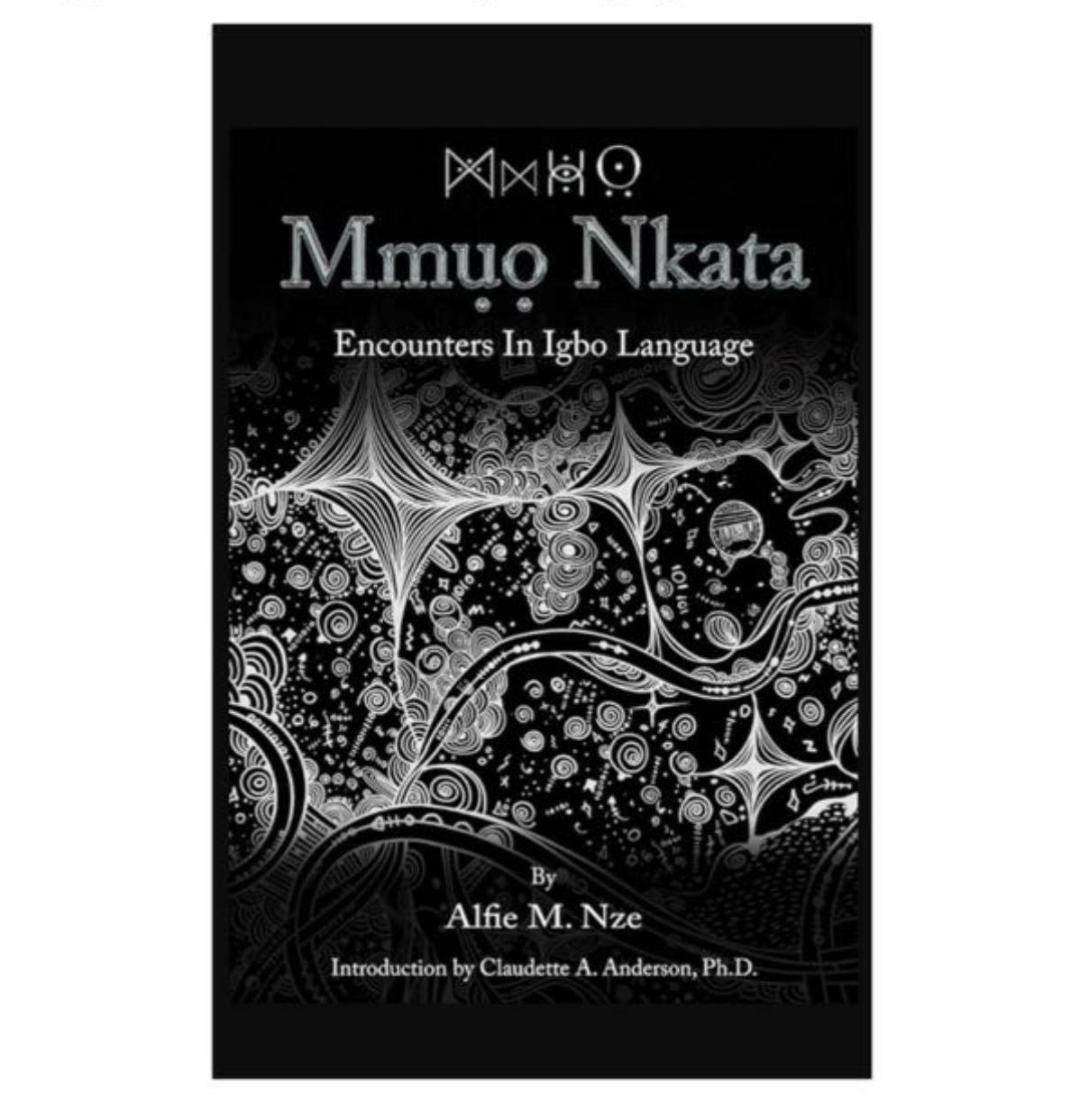
I have explored this concept in my book Mmụọ Nka+Ta(a), so I will not pursue it further
here.
My grandfather was said to be the first man to build a compound in what is today our
community. He raised a large house in an uninhabited forest aptly named Ọhịafọr, the
forest of Afọr market day. It is told that he fought off many spirits opposed to his
presence there, and that, great mystic that he was, he matched them fire for fire until
they were subdued. His two wives, my grandmothers, joined him in the battle and were
reputed in some ways to be fiercer than he was. It is said that after cutting the roots of a
tree, these would grow back stronger overnight, and that their cutlasses broke at every
stroke. The battle my grandfather and his wives fought to settle there is still remembered
today in my community. He, his wives and their many children lived alone in that
compound until others, seeing that no great harm came to them, joined them. The
newcomers built around the compound until the frightful forest was conquered and
became our community today.
My father was the Ọkpara, the first son so coveted in every important Igbo household. As
such, there were unspoken rules about the family he could marry into, and when it was
time for him to take a wife, my grandfather opposed one proposed bride after another.
Then the woman who would become my mother was proposed, and my grandfather
agreed, because of her elder brother, the man who would later become my maternal
uncle. It was not the young man’s standing that persuaded my grandfather; my uncle was
then almost of the same age grade as my father. It was that my grandfather saw in him
the seeds of a great Dibia like himself. He must have reasoned that a family capable of
producing such a young man was worth marrying into. The marriage that produced me
was contracted, in other words, on an act of recognition, through the eyes of an ancient
Dibia.
Later in life, my maternal uncle became a Dibia of great repute, in his community and
beyond. He was a man of a particular breed, who ate sparingly, spoke in low tones and
measured words. His food was mainly yam, which he prepared himself, even during his
many years in Northern Nigeria, far from Igbo land. He returned home from the North
to take a wife and settled into the life of a mystic. By the ancient practice of the branch of
Igbo mysticism in which he was an adept, nobody, not even his wife, was permitted to
touch his food or the pot it was cooked in. Until his death, he never sat on a stool without
first covering it with a white or red cloth. It was his unexplained daily ritual, a gesture
that separated the seat of a man of his calling from that of an ofeke, the uninitiated.
After my father’s death, I lived with my uncle for a term during elementary school.
Throughout those months he took it upon himself to wake me very early each morning.
His wife, my aunt, was there, and he had no reason to do so, yet he made it seem a duty.
We do not have a culture of transmitting knowledge through many words, and I think
my earliest training in observing Igbo cosmology happened under him: he taught me
without seeming to teach, simply by allowing me to observe some of his activities. It did
not take me long to understand that his eating was not a diet. Yam among us is not
merely food; it is the proto-Igbo food, the first substance, the crop around which title,
calendar, barn and manhood were organised. Iri Ji, the New Yam Festival, remains the
most important celebration in Igbo land and among the diaspora. To eat yam the way my
uncle did, alone, prepared by his own hands, in a pot no one else could touch, was less an
act of the body than of the spirit. A man keeping himself in continuous contact with the
most symbolic and mythological food of the Igbo was saying something unspoken to the
world and to his own spirit.
He had been given the terms of that near-worship of the yam early in life. When my
grandfather recognised what was in him, he did not leave the recognition unexplained.
He gave the young in-law a sentence to carry all his life:
“A single yam in a barn can regenerate and repopulate an entire village.
But that regeneration is impossible without living in harmony and the
consent of Ala.”
My uncle repeated it all his life, and I heard it many times before I had any idea what it
was doing to me. Spoken to a young man whom a respected Dibia had recognised as a
seed, it must have read as both a promise and a warning. One yam holds an entire barn
and village inside it, but only if it is given to the earth with respect. The seed alone is
potential and nothing more; it is Ala who converts potential into multiplication. Much of
my work decoding the metaphysics and philosophy embedded in everyday Igbo language
is, I think, a re-elaboration of that sentence.
Then one night, like my grandfather, my father and many relatives before him, my uncle
joined the ancestors peacefully. It was the kind of death the Igbo consider most fitting for
an elder: arriving quietly, rather than as an endless battle that wears down the soul and
strips the body of its dignity. For a man of his stature, the burial would involve several
passages before the ceremony itself could be performed. He had asked for “ichere n’ime
Ala,” literally a waiting place in the belly of the earth: Ala’s respected child must be
returned to her belly once ume, the breath that contains life, leaves his body. He had
expressly requested that his body not be taken to the freezer of a mortuary.
My mother and my late uncle were very close. He had been a pillar for her when my
father died while I was still very small, stepping, unasked, into the space my father’s
absence had left. Their bond was unbreakable, of a kind I have never seen in our
traditionally conservative society. His death left me, and everyone in the community, on
edge for fear of how my mother would take the inevitable news. Many came to see “Mma
Oyibo,” as she is called, and spent hours with her, telling her, “Mma, ka anyị kele
Chineke, nwanne gị anwụchidụ anwụchi”: that we should thank God her brother had not
met an early death, that his was not a death to mourn as tragedy but to receive as natural
passage. Mom cried, but not with wailing. Her crying moved between speaking and
singing, the two so close that it was sometimes hard to tell where one ended and the
other began. Of all the deaths my family has suffered, only two moved such emotion in
her: my father’s and that of Ihuarugo, my maternal cousin. I remember her calling my
father’s name now and then, asking him who would train the two little boys he had left
behind. She cried the same way about Ihuarugo too, telling her that an Ada -the first
daughter in every family- should not die before her father. I was more worried for my
mother after Ihuarugo’s death. My mother sort of poured her love for my uncle into
Ihuarugo, his first daughter.
After my uncle’s death, his only son was left with the laborious task of arranging the
funeral. He began the round of visits to the elders of the various Nze na Ọzọ titles my
uncle had held, each visit with its own negotiation, large or small, over protocol and over
who would do what first. Worn thin by the sheer administration of grief, my cousin
lamented at times, yet bore his burden with the inescapable dignity expected of the first
son of so great a Dibia.
Then, on what began as an uneventful Sunday at the height of the rainy season, I
received an emergency call from home in Ọhịafọr. A neighbour had rushed into the
compound and, making sure she was well out of my mother’s hearing, whispered
disturbing news:
“I dreamt that Mom had died, and I was the only person crying. Many
people were around, but everyone watched without consoling me. I think
her brother’s funeral will be soon, and he is calling her to go with him.
Call Ndubuisi, tell him to do Afa; something must be done before the
worst happens.”
She marched away once the message was delivered; she had fulfilled her duty to it. In our
understanding, a dream like that is not idle. It is an instruction, and such instruction left
undelivered becomes the messenger’s burden.
I must say a few words about names in some Igbo families. A child may bear up to four
names, depending on the closeness of those who named him to the family. His parents
would give him separate names according to the emotions attached to his birth. Then his
maternal, or maternal aunts and uncles will also name him separately. Then Christianity
steps in to also take a piece of the naming cake. But make no mistake, anyone who knows
a man deeply knows all his names.
My mother named me Ndubuisi, meaning “life comes first.” But my father, evidently
concerned about family legacy called me Eziefule: “My family name will never be lost.”
Most people in my community call me Ndubuisi, but when an occasion concerns my role
as the first son of my father, the men address me as Eziefule. Very few call me Alfie.
So, after the neighbour’s alarming dream, I was called to act. And as with everything that
involved my mother, I had to act fast. My mother has reached that stage of life at which it
is almost impossible to imagine a person was ever a child. In a word, she is very elderly.
She belongs to a generation of elders who did not measure their presence on earth by
dates of birth and birthdays. Her age sits in the space of “ọ bụrụ Chi kele Chi,” ancient
space in which age is not counted individually but collectively, among age grades, in
gratitude simply for seeing the light of each new day. One’s age is not recorded in any
book, only accumulated, the way sediment gathers without anyone counting the layers.
I quickly called a Dibia I know in Anambra and asked her to consult Afa for my mother.
“Ndụ ya ọ dị kwa?” she asked. Was Mom well? She was trying to understand why I was
calling with such urgency after years without speaking to her.
“Enwere ihe mere oke ọkpa ji ebe akwa n’ehihe.” “A cockerel cries in the afternoon for a
reason,” I said in a proverb.
After the pleasantries owed to a Dibia one disturbs unannounced, I explained that I was
enquiring about my mother’s wellbeing.
Afa proceeded in the cryptic language of the ancient practice: the breaking of kola nut,
the low tones of incantation, the scattering and gathering of the instruments across the
floor. She paused now and then to ask questions, and I answered, choosing my words.
“Enwere onye nwụrụ n’ịkwu nne gị?” She asked whether someone had died recently in
my maternal home, and I said yes. For a reason I could not name, I hesitated in my
answers, yet I did not withhold anything vital. At some point I noticed that some of the
words were directed at me, away from the enquiry about my mother. So when the floor
was opened for my questions, I sought more light.
“Ọ rika afa gwaga mụ okwu n’agbasahụ ajụjụ m jụrụ gbasara nne m,” I said, indicating
that I had noticed Afa addressing me, beyond the question about my mother.
“Ị ma onye loro gị ụwa?” she asked. Did I know who had reincarnated me? I said I did,
and she returned to question Afa.
“Are you sure this is the name?” she asked, looking at me with some doubt while
studying the positions of the cowries on the floor.
“Yes, of course,” I replied, with absolute certainty.
“Who carried out the divination? How did you find out the name?”
“My father did it when I was newly born, as our tradition demands.”
“Something is not very clear. The spirit you are calling is here, but he is not responding
as your reincarnator. I will go and see a Dibia more experienced in Afa agụ. I will get
back to you in three days.” And the consultation ended.
I stared at my phone for what seemed like ages. I had gone from worrying about my
mother to discovering uncertainty about my own spiritual DNA. I was not prepared for
the feeling, though I trusted that all would turn out well. Only later did it strike me that
the Western scientific frame of reference has no vocabulary for what I was going
through. No test, no swab, no laboratory could adjudicate this kind of parentage. A
genetic inheritance is legible in a strand of DNA passed silently from cell to cell. A
spiritual inheritance, it turned out, could be announced casually and aloud by a stranger,
through a telephone network far younger than the thing it carried. What had been
certain less than an hour earlier could be revised, and confirmed only after a second,
sometimes a third, opinion. Inheritance, I understood, is an ongoing conversation
between the living and the dead, not a fact settled at conception. And unlike a genetic
result, which tells you only where you came from, this one tells you what you are
answerable to. To be named as a returning spirit is to be handed his reputation along
with his name: his debts as well as his standing. The account, the Dibia had told me, was
still open. I was confronted with the ancient philosophy of “ihe kwụrụ, ihe kwụrụ ya
n’akụkụ,” that when something stands, something else stands beside it. But I could no
longer be sure of the Chi, the Energy, God head or spirit, that stands beside me.
Two days later she messaged me, asking for the names of relatives who had died before
my birth, from my maternal to my paternal great-grandparents, including my uncles. On
the third day, as promised, she sent a series of voice notes: her conversations with the
older Dibia and his divination on my behalf. Although I had been waiting for it, the result
struck like a violent storm out of a clear blue sky.
“Ọ bụrọ onye ị kpọrọ afa loro gị ụwa. Onye loro gị ụwa bụ nna, nna, nna gị,” she
explained in a further voice note. According to the elder Dibia, I am the reincarnation of
my great-grandfather.
This was a most surprising outcome. It is not that a great-grandfather cannot return; the
lines of reincarnation are broad, and a man may come back through a nephew, a
grandchild, the son of a friend, anyone the community still holds in memory. My
great-grandfather does live on: I am, in fact, expected to take his title, the title of my
grandfather and my father. My shock was that, by this result, he displaced my
grand-uncle, Nwagụnkwụ, a man whose every anecdote I knew; a man whose fears I do
not carry, but with some consequences of whose actions I live, too broad for this piece.
Once, when I was very small, in elementary two or three, I fell seriously ill around my left
heel and could not go to school for months. Another boy, Jacob, had fallen seriously ill at
the same time and could not move his left foot either. My father and his consulted two
different Dibias, and both came back with the same verdict: the root of a nearby iroko
tree had pierced the left foot of Nwagụnkwụ, our reincarnator. The tomb had to be
opened and the root removed. Jacob’s father and mine met at the tomb-opening
ceremony, neither having known that their sons shared a reincarnator. I recovered soon
after the ceremony, and so did Jacob.
Something occurred to me as I listened to the voice notes. My grandfather had once
looked at my future uncle and seen what was latent in him. About a hundred years later,
another diviner, speaking through the speaker of a mobile phone, named something
latent in me that I had not known. My family has done this for as long as anyone can
remember: recognising people for what they are. I had always counted us among those
who recognise; I never imagined I would find myself on the receiving end, of
non-recognition.
I was plunged into a crisis few would understand. One can make peace with the living,
but when the DNA in question is of the spirit, the crisis becomes metaphysical, and there
is no court, registry or biological instrument to appeal to. There was only my mother, the
divination, and the widening gap between the name I had worn since birth and the one
Afa now insisted was mine.
“Mma, onye gbara afa ilo ụwa m?” I asked my mother, wanting to know how the name
of the spiritual identity I had carried all my life had been found.
“Ọ wụ nna gị gara ije ya… maka gịnị ka ị ji ajụ ụdi ajụjụ-a?”
The unusual question irritated her. It was my father, she said, who had made the journey
of divination at my birth. Then she asked why I would be going on such an errand or
asking such questions at all.
I could not tell her that I had consulted the Dibia for her sake. So I said the enquiry had
come from some recurring, disturbing dreams, and then I told her the result of the Afa
and who carried it out. First she scoffed; then fell silent for a long while. When she spoke
again, I could hear that her words were carefully chosen.
“Gịnị ka ị gara Anambra eme? Ọ pụtara n’anyị enwdụ Dibia n’ala anyị? Mmadụ ọ
n’achọ ihe nọ n’ụlọ n’ama?”
“Why did you go all the way to Anambra? Does it mean that we have Dibias here?” Her
last question was the code telling me to retrace my steps and look for my answer closer to
home: “Does a person go outside to look for what they have at home?” My mother did
not tell me what to do, yet she told me.
I understood, yet I was in a turmoil. All my life I had known every important anecdote
about the man I believed had reincarnated me. In his earlier life, Nwagụnkwụ was the
younger brother of the man who has returned as my brother in this life. He had
promised to be reborn into the same family as his brother, but to come back as the elder.
I am older than my brother, as Jacob is older than his. Nwagụnkwụ returned in four
families and kept his promise every time, coming back as the elder. Everybody in my
community knows the story. The divination in Anambra had unsettled that certainty.
So I took my mother’s hint. I would consult Afa agụ again, closer to the ground that holds
the same sand as was under my feet and under the feet of the two ancestors now
contending for my spiritual DNA. I did not need a distant Dibia, nor a voice note
interpreting the intricate Anambra Dibia language, as did the lady. I would consult a
man rooted in the same soil as my ancestors.
Some days later, on Nkwọ, the market day of my birth, an ancient Dibia pronounced the
very name I have worn like a second skin.
“Nwagụnkwụ nọ ngaa. Ọ wụ ya loro Ndubuisi. Mana ọ si Ndubuisi g’ebubata Ikenga
ukwu ya.” The recorded voice from my phone quieted me. “Nwagụnkwụ is here. He
reincarnated Ndubuisi, but he says Ndubuisi should bring home his great Ikenga.”
I had not known of any great Ikenga. I am not in contact with the others who share this
spiritual ancestor with me. Had we been close as adults, I would have asked them some
questions, but I had no wish to go on a wild-goose chase that could turn ugly. Not many
Igbo people today are interested in, or in tune with, their original spiritual selves.
Those five days were a metaphysical rollercoaster. They did something to me, producing
this essay and other work that will follow. Strangely, I was grateful, because I came to see
the necessity of a shaken certainty. What began as a scare about my mother’s mortality
became an unexpected education in my own physical presence and my future passage.
It would be easy to leave the story there, as a private drama resolved. But the question it
raised would not stay private. For five days I had stood outside the circle of my own
recognition. The only reason I could step back inside was that the circle was still there to
receive me: a mother who remembered who had gone for Afa at my birth, a Dibia rooted
in the same soil as my ancestors, a community that still tells the story of Nwagụnkwụ and
his words. My uncertainty was brief precisely because everything that makes recognition
possible was intact. I began to ask what it would mean to face the same question with
none of it: no mother to ask, no soil to return to, no one left who remembers the story.
That question carried me, as maybe it was meant to, across the Atlantic.
I realised why I have always felt drawn to our brothers and sisters across the Atlantic
who are retracing steps lost in the oceans and fields of slavery. I have always marvelled at
the efforts of some to speak the Igbo language, not merely speaking it but trying to get
the pronunciation right, while we who were born into the language and culture are
happier to exhibit our near-perfect British or American accents. And why we are being
reduced to performing our being Igbos by wearing red caps of dubious origin and ishi
agụ dresses at ceremonies. Those five days gave me a slight glimpse into the DNA kits,
archives, surname searches and village enquiries of descendants willing to go to
impossible lengths to discover their origin. They reaffirmed my dedication to decoding
the complex codes hidden in the Igbo language. I realised that I am called to do more in
the search for continuity with the diaspora, a quest most of my contemporaries ignore.
“Mana ọ wụ onye na Chi ya”: a person operates according to the dictates of his Chi,
which is what makes the Igbo system so liberal.
Through those five days, I fully realised that what slavery severed was not only language,
lineage, culture and original spirituality, but the very condition that makes return
legible: the company of people who knew the departed, who could look at a child and say
whose gestures those were. Where the diaspora searches for names erased by ledgers and
auction blocks, my crisis was the opposite: an accepted spiritual identity, worn like a skin
and never doubted, until Afa insisted otherwise. Once more I saw the fundamental role
of our culture as a spiritual and physical compass. It is not a fixed map handed down
unchanged. It is a delicate, living, arguable, imperfect system which nonetheless insists
that the dead are not finished with us, and that we are not, in the end, self-authored.
I was not reciting a doctrine that week. I was drawn back into the workings of a system I
had taken for granted because it was so readily available. I passed through what keeps
the dead within the circle of the living, and what keeps the living accountable to a circle
they cannot leave by dying, because that circle is always complete. Genetic ancestry tells
us where our chromosomes came from. Ilo ụwa asks two harder questions: how many
lives do we live within a given circle, and who will be living with what we leave behind?
But it is precisely here, where the system works, that I want to name what it cannot yet
do. I put it to the reader as a challenge rather than a conclusion.
If recognition depends on communal memory, what happens to those whose lives,
memories and communities were taken from them? It was not the loss of a hundred men
and women. Millions were removed by different mechanisms. Taken across the ocean
and over four centuries, into a condition designed to break the very faculty the belief
relies upon: the naming through divination, the age-grade system, the compound where
each person’s habits were known well enough to be recognised in a newborn child. The
rupture happened on the mother continent too. Families were emptied of sons and
daughters who were never mourned, because no one knew they had died. The oceans and
fields of the Americas and beyond are inhabited by ancestral spirits severed from us for
hundreds of years: people whose lives and deaths left no burial, whose names fell out of
the anecdotes, whose titles were never conferred, and for whom, by the logic of ilo ụwa,
no return can be pronounced. They are not forgotten in the casual sense. They were
unmade as recognisable persons, their trails severed.
I do not know how to knit the lost spiritual thread back together, and I am a little
suspicious of anyone who says they do. But I am certain the question is worth asking,
and that no single discipline holds the answer. Archives alone cannot do it, and my heart
cries to write these words: the ledgers recorded cargo, not human beings. Genetic testing
alone cannot do it. It can return a region, a probability, a country that did not exist in the
form Europeans put together for their own interests, but it cannot return a name, a title,
a compound, or the relationships between families, kindreds and larger communities.
Divination alone cannot do it either, not when the community that made recognition
possible has been dispersed and its storytelling broken. The problem sits in the space
between these instruments, a space where none of them is currently obliged to work.
So this is the challenge I want to leave open. I address it to the honest Dibia who knows
what divination can and cannot reach, and under what conditions it might reach further,
across centuries and oceans. I address the historian and the archivist, who can read what
the ledgers concealed as well as what they recorded; the geneticist willing to treat a result
as the beginning of a question rather than its end; the artists, writers, sculptors and
musicians. I address a group whose work I hold in particular importance: the linguists.
Some sounds survived, in Antigua, Cuba, Brazil, Jamaica and elsewhere. Perhaps what
makes a person recognisable could be hidden in the curves of the tongue, or in the sound
of an ancient instrument. Perhaps, in the end, an act of imagination spoken aloud and
performed in public might be a step towards spiritual reconnection; art, as we know, has
always been our most patient instrument for reconnecting the human spirit. Above all, I
address the elders who still hold what is left of the telling, whose transmission of
memory is the infrastructure on which everything else would be built, and who are the
custodians of what we are losing fastest.
Much has been invested in treating diaspora reconnection as a matter of travel,
ceremony and citizenship. These matter; they are fundamental to reconnecting over four
hundred years of severed roots. But since a human being is both body and energy, or
soul, a deeper spiritual reconnection must bring ilo ụwa and similar practices of the
mother continent into the conversation. Ilo ụwa is a return to a place and a people who
hold and cherish a person’s memory; we have to find ways to include the spirit’s journey
in the work of reconnection. That work is not the property of any one profession. It will
be done by all of those I have named.
I do not claim to have arrived anywhere. This account of my encounter with what I had
taken for granted is a report from a personal “middle passage”: from certainty, through
uncertainty, to certainty re-established. But I would rather continue this journey of
reflection in company than alone, so I offer it as an invitation as much as an argument.
I have come to organise this thinking around the Igbo word and philosophy of Otu. Otu
means one, circle, community, group or gathering, and that multiplicity of meaning is, I
think, what makes the spoken language vital to the journey of physical and spiritual
reconnection. One cannot be without the others. In Igbo, you do not become a person in
isolation and then join a community; you become whole through ndị otu gị, those of your
circle. Imagine you are in a race with others and “ị gbaa otu”: you arrive number one.
Only if the others arrive with you can they attest that “ị gbara otu,” that you came first. If
they stopped somewhere and left you alone, “ị g’agba otu”: you would still arrive number
one, but first in the middle of nothing. Recognition is an act performed by ndị otu gị, by
those who see you, those of your group. No circle, no return.
Since the codes of Igbo of the Igbo language are hidden in pronunciation, the word Otu
carries a further sense that I did not expect to need when I began writing this. “Ọtụ” is
the female sexual organ. In this context it carries the meaning of a portal of entrance and
exit into the womb. It further signifies the place of origin, of nurture, of coming and
leaving through the belly of Ala, the Earth God. So the same word holds the gathering
and the site of return, the circle that recognises a man and the body through which he
arrives.
And here the sentence my grandfather gave my future uncle, the young man he had just
recognised, returns with its full weight. As long as it is in the circle, a single yam in a
barn can regenerate and repopulate an entire community. Just like a glass of water holds
the entire information of where it was fetched, a yam seed carries the whole barn inside
it, yet can do nothing with it alone. In Otu, our existence is relational all the way down:
the yam needs the earth, the one needs the group, the returning spirit needs the circle
that can recognise him. This is why I call Otu singleness before difference. Before the
arguments of state, party, denomination and dialect, there was one breath; the
differences that came afterwards are real, but they are not the foundation. Otu does not
ask anyone to become the same. It gives difference a home.
That is why Otu, the initiative I founded, rests not on agreement but on reconnection
with the essence of who we are: “Awụ m Otu maka enwere m ndị Otu.” I am number one
because I have a community. If the circle is what makes a person recognisable, then a
circle broken by more than four centuries of severance is not a historical grievance to be
catalogued. It is a living metaphysical problem to be resolved, and it is ours to resolve.
So I end with an invitation rather than a conclusion. To Dibias, scholars, archivists,
geneticists, artists, elders and activists, and to anyone who simply feels the pull of the
severed line: bring what you know, whether a divination, a document, a language, a
lineage, or a question you have never been able to put down. The conversation is open at
otu.com.ng.
I am a yam in a barn, and so is everyone reading this. Alone, each of us is only potential;
together, in Otu, given ground to stand on, and the earth to plant our yams, we become
the barn, the community repopulated. What we seek is reconnection with the
civilisations of our origin.
The circle is always complete.
Alfie Nze is author, filmmaker, theatre and opera director. He is the author of the book
Mmuo Nkata.