
Multi-Interdisciplinary artist and sculptor, Akeem D. Adedeji places emphasis on dialogue on culture and identity in the art collection comprising culturally themed subjects enriched with symbolic objects.
Using metals and woods as artistic media, Akeem revives fading cultures through sculptures. The collection captures the essence of African identity and prevailing socio-cultural realities with a modern twist for present-day audience.
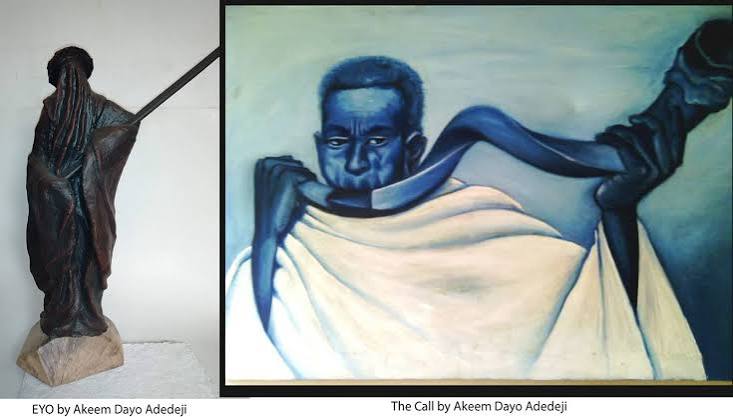
The collection consists of three intriguing titles that include Eyo (2015), Bold (2015), and The Call (2014), featuring various socio-cultural symbols through portraitures.
Conceptualization of the sculptures indicates a technique that involves a combination of both traditional and contemporary storytelling methods in order to craft the visual narratives.
For many years, the artist has expanded his practice from sculpture to incorporate other genres of art and craft. The artwork recreates social rituals that capture local traditions and beliefs in the context of digital mediation and new civilization.
Akeem uses a variety of materials and patterns for remodeling the surface, shape, and motif to stage personal encounters as well as objectified tactile experiences.
“Eyo” (mixed-media 18x 25 inches), “Bold” (oil on canvas -24×36 inches), and “The Call” (oil on canvas -24 x 36 inches) represent the use of material metaphor for cultural documentation and description of identity by Akeem.
The word, “bold” is an appropriate symbol, which is represented with the image of a leopard. The artist takes advantage of the tactile characteristics of the animal, depicting it with oil and other materials including the spots, fur, carriage, intimidating presence, etc.
With its awe-inspiring demeanor represented through careful patterning and texture, the leopard looks striking. With the help of his handling of oil in the composition, and expanding the scale, the artist emphasizes the surface detail. Through using meaningful marks in order to depict the animal form and its character, the artist makes realistic impressions that will engage the viewers. The representation of leopard as a lone, yet brave animal functions as a symbol of resilience and confidence.
Akeem deliberately uses the animal metaphor as a model for boldness in tough situations where individuality is important. The viewers may question themselves as to why the artist decided to use the four-letter word, “bold” to describe the African leopard. Such questioning position helps the viewers to recall their personal, emotional, and collective experiences embodied in the image: lonely and difficult times that called for courage or resilience, confidence, and victories.
With “The Call” (2014), which represents the figure sounding a traditional horn, Akeem reproduces long cultural practices where the “horn” is used symbolically for summoning people for the sake of wars, religious worship, and important ceremonies. The composition revolves around a communicative gesture with the horn functioning as the symbol of an authorized messenger whose posture indicates that the horn is sounded for a certain reason.
The artist creates suspense stylistically, positioning the image for audience interaction through not stating what “the call” is for.
Akeem uses oil for providing details about the complexion of the skin, color of the cloth, and the horn as the instrument of power. However, the artist does not provide too many details, creating a window for the viewers to extract hidden meanings and, possibly, fill the conspicuous space with their thoughtful answers to the reflective questions regarding the imaginary sound that comes from the figure.
Akeem uses some objects like the horn metaphorically as the elements of history, culture, and social messaging, thereby reviving slipping cultural practices on canvas for the target audience.
Among the indigenous signifiers are the instruments used in pre-colonial times for summoning, warning, and storytelling. In other words, Akeem revives pre-colonial technologies and traditional models of communication of the embedded ideas to the audience.
One of the pieces, “The Call” showcases the continuing importance of some communal practices in the urbanized society.
Apart from the strong conceptual clarity, culturally relevant subject matter, and evocative images, the collection attracts attention through sound and visual resonance inherent in symbolic elements.
Akeem’s experiments with mixed-media give the framed surface the rough, weathered, and earthen texture, which aligns with the local objects and materials used in traditional practices, involving rituals and festivals.
Eyo in the collection is deeply rooted in the Yoruba ceremonial life with particular focus on the civic pageantry annually celebrated in Lagos.
Instead of casting the Eyo in the festival mood on canvas, Akeem uses abstracted forms for highlighting its essential parts that include veil, staff, and meaningful posture in a modest sculpture that will attract viewers for closer interrogation.
Thus, the viewer becomes an active participant of the exploration process, as the artist creates intimacy by connecting the tactile experience of the figure with the participation of the audience.
In terms of visual qualities, Eyo is curated as a compact sculpture with the culturally resonant appearance. Among other things, the theatrical costume of the figure is similar to that worn by the masquerade in South-West Nigeria, Lagos.
With the help of Eyo as the cultural icon, Akeem stages iconographic art with the masquerade dressed in a way reminiscent of the African traditional dances where the masked beings impersonate deities, mimicking ancestral voices with guttural sounds.
The viewers can interrogate the figure further for extracting the implicit cultural messaging that the kinetic symbols, shapes, and varying shapes entail. The emphasized features can also serve as the guideposts for uncovering the whole tale.
Akeem’s craftsmanship includes knowledge, talent, and conceptual mapping. In this collection, the artist brings together his training and expertise in sculpture, long experience in fabrication, and knowledge of materials cutting across different genres for creating harmony in the narrative sequence and conveying his intended message.
Apart from sculpture and painting, Akeem uses traditional motifs for connecting the viewers to his visual documentation of archived history and memories of collective experiences. For example, in Bold, the artist depicts a leopard as the archetypical animal modeling bravery, quiet strength and other attributes of boldness. The figure also raises thematic concerns related to cultural heritage and identity, which are basically achieved through the African origin of the animal and its famous golden fur and black spots.
Akeem also stages masquerading and other performative arts for connecting viewers to the dominant socio-cultural practices by using the local instruments like a staff as the signal of authority. Akeem stands out as an artist stylistically applying various patterns to express identity as the phenomenon encoded in the objects, gestures, and surfaces.
Akeem’s work brings up culturally resonant themes that are depicted through the masterful combination of materials and various techniques.
The diverse thematic concerns are, however, interconnected through a single thread, resulting in the cohesive and coherent composition that communicates clearly to a large audience.
Conversely, galleries, art collectors, enthusiasts, and even critics will find the work sufficiently engaging for exhibitions, decorative purposes, or promotion of the cultural heritage.
The artist whose ingenuity and connection with cultural motifs make his work captivating, masterfully translates the conventional tropes into fascinating sculptured visual narratives.
Besides attracting the prospective viewers through the aesthetic quality of his work, the artist expands his experimentation in terms of material and genre integration resulting in media hybridity, scale expansion, and nuanced sculptural displays.
Through his participation in art exhibitions and commissioned works, the creative has made a lot of contribution to conversations in contemporary Nigerian art and culture discourse.
Credit: Vanguard