

The Gulf Arab States are becoming increasingly important hubs for the international art world, spurred by a mix of state-led investment in cultural infrastructure and a growing private sector, including major art firms like Art Basel and Frieze, which have both expanded into the region in the last year.
In addition to new fairs, there are other homegrown initiatives on the horizon, too, including the third edition of the Diriyah Contemporary Art Biennale in Saudi Arabia, opening in at the end of January, and Rubaiya Qatar, Doha’s new quadrennial launching in November, making 2026 a landmark year for contemporary art in the region.


So, who are the Gulf artists worth knowing? We asked several of the region’s curators, art advisors, and art-world insiders to share who is on their radar. The eight artists listed below have been steadily garnering attention both regionally and internationally over the past few years. Though they use vastly different media, their work shares an authentic and intimate openness that echo aspects of the socio-cultural changes taking place in the Gulf and the wider Arab world, brought on by rapidly developing economies and geopolitics. They all tread a delicate line between respecting tradition and cultural heritage while taking artistic and intellectual risks.

“I think vulnerability is a political act,” said Alexie Glass-Kantor, Art Dubai’s new executive director, on the formal qualities that unite these artists’ works. “To have a degree of uncertainty, to have the work hold ambiguity and hold contradiction is a very powerful place to occupy at a time where people are increasingly falling along the lines of algorithmic binaries.”
Mohammad Alfaraj (b. 1993)

A work by Mohammad Alfaraj. Photo: courtesy of ATHR gallery and Mennour.
Born in the eastern Saudi city of Al Ahsa, Mohammed Alfaraj is a multidisciplinary artist working across film, photography, installation, writing, and sculpture. His practice is rooted in the palm oases and agricultural landscapes of Al Ahsa and has quickly garnered attention for the way in which he thoughtfully weaves historical memory, ecological storytelling, and community into deeply poetic works that are as conceptually challenging as they are intellectually rigorous.
“At a time when so much contemporary art operates at exaggerated volume, Mohammad Alfaraj’s practice is the opposite,” said independent curator Maya El Khalil, who has worked with Alfaraj since 2017. “There is a distinctive humility and tenderness in his practice, especially in the ways he engages with nature and the communities that live in nurturing relation with it.”
It’s been a big year for Alfaraj. In May, he received the Art Basel Emerging Artist Award in Switzerland and, more recently, the Art Basel Gold Award in the Emerging Artist category during Art Basel Miami Beach. His work was also shown at the Saudi Pavilion during this year’s Venice Architecture Biennale. Meanwhile, the artist’s first institutional solo show, “Seas are Sweet, Fish Tears are Salty,” is on view through January 4, 2026.
“From a market perspective, we’ve seen a clear shift in how collectors engage with Mohammad’s work,” said Mohammed Hafiz, co-founder of Jeddah’s ATHR Gallery, who presented the artist’s charcoal-on-paper works at Abu Dhabi Art in November. “He’s become a key name on the list of collectors looking seriously at the region.”
Dana Awartani (b. 1987)
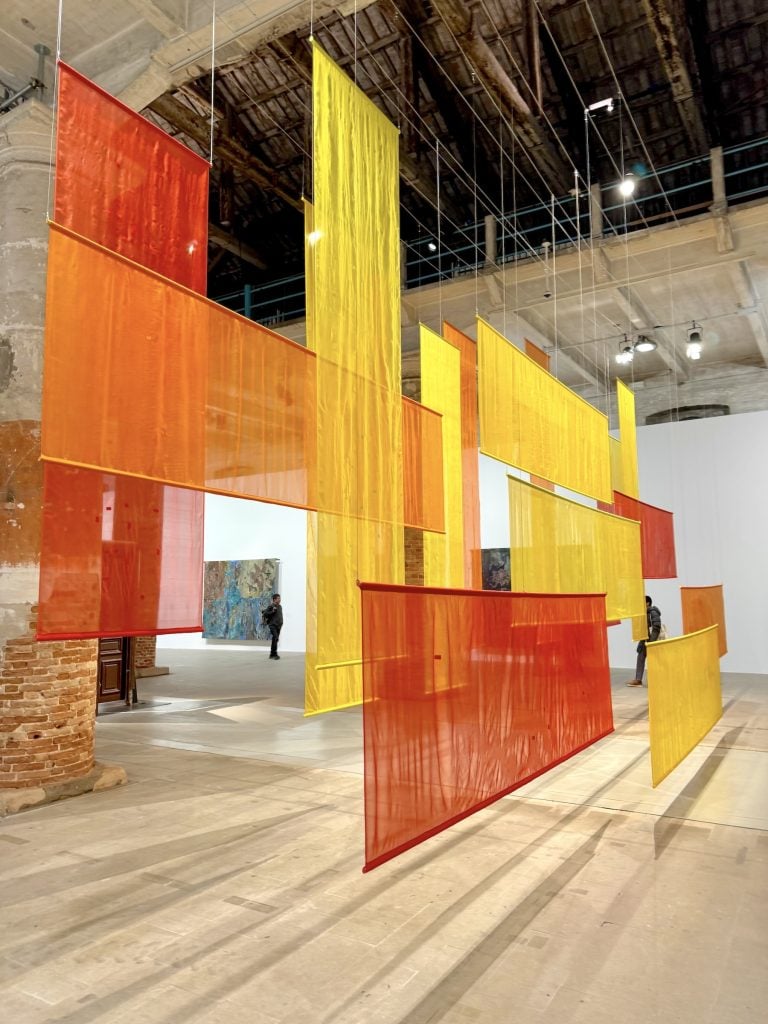
Dana Awartani, Come, Let Me Heal Your Wounds. Let Me Mend Your Broken Bones (2024) at the 60th Venice Biennale. Photo: Ben Davis.
Born and raised in Jeddah, Saudi Arabia, and of Palestinian descent, Dana Awartani is known for her material-focused work that explores craft, cultural heritage, and memory. Her gauzy fabric installations, like Come, let me heal your wounds, let me mend your broken bones (2023), which featured in the main exhibition of the 2024 Venice Biennale, often delicately map sites of architectural damage due to conflict. In 2026, she returns to Venice, this time to represent Saudi Arabia at the 61st Venice Biennale.
Though she trained as a master-artisan, first at Central St. Martins School of Art and Design and then at The Prince’s School of Traditional Art, both in London, she “speaks the language of contemporary art,” said Antonia Carver, director of Art Jameel and curator of the Saudi National Pavilion.
“In her practice, Awartani enacts her urgent subject matter in material and process,” noted curator El Khalil, noting that the artist often collaborates with master craftspeople “What she does is so much more than the preservation of traditional techniques or aesthetics; it’s an active reckoning with temporalities of loss and mourning.”
Maitha Abdalla (b. 1989)

Maitha Abdalla, The Escaping Shepherd (2023). Courtesy of Tabari Art Space.
Maitha Abdalla has quickly gained critical attention over the past few years for her surreal canvases portraying imaginative characters, and her performances centering around local folklore, femininity, and domestic power relations.
“We were drawn to her painterly and performative language, which connects the body to its social conditions,” said her gallerist Maliha Tabari, who first presented the Emirati artist’s work at her eponymous Dubai gallery in 2021 and in a presentation at London’s Cromwell Place, supported by Abu Dhabi Art. The dual outing opened up “dialogues with collectors across the Gulf and Europe.” Demand for Abdalla’s work has grown steadily since then, with prices rising from $4,000 to $4,500 for early pieces to $55,000 for recent large-scale oil and charcoal canvases, like Between Chaos and Renewal, a Broken Spring (2023–25).
Born in Khorfakkan, a coastal town in the Emirate of Sharjah, Abdalla has been showing her work consistently on the biennial circuit, including at the 15th Sharjah Biennial in 2023 and the most recent Aichi Triennale in Japan, which closed at the end of November. She is currently participating in the Sharjah Art Foundation’s Residency Program 2025–26.
Farah Al Qasimi (b. 1991)

Farah Al Qasimi, Living Room Vape (2016). Photo: courtesy of the artist and The Third Line, Dubai.
Dividing her time between New York and Abu Dhabi, Farah Al Qassimi has become known for her multidisciplinary work and its particular use of color, photography, and humor to offer social commentary. She has rapidly become “one of the most closely watched artists of her generation for her singular ability to find the uncanny within the everyday, through vividly staged photographic worlds,” said Sunny Rahbar, co-founder of Dubai’s Third Line Gallery, which has represented the artist for more than 10 years.
The Emirati artist has had solo exhibitions at major institutions, such as Tate Modern in 2024, C/O Berlin in 2023, and Delfina Foundation in London in 2023. This year, she received the prestigious Guggenheim Fellowship to continue her research and practice in contemporary photography. Collectors have followed the trajectory of Al Qassimi’s market closely, with strong demand on the primary market and consistent placements in major museums, including the Guggenheim, MoMA, Tate, Centre Pompidou, SFMOMA, and LACMA.
“Farah has an extraordinary eye and capacity to spot and capture the mis-en-scene of the every day,” said Carver. “She occupies a very particular position within the UAE arts scene, combining an immersed, fond familiarity for her subject with a quizzical, one-foot-out lens. Her images are steeped in clashing color and flashing light, and she relishes the drama of the outlet mall or folk tale, yet they somehow never tip over into anthropological exotica.”
Hashel Al Lamki (b. 1986)

Installation view of Hashel Al Lamki’s “Sensu Lato,” 2022. Courtesy of Tabari Art Space.
Emirati artist Hashel Al Lamki’s work is defined by material invention and continual interest in the relationship between people and their environments. He graduated from Parsons School of Design in 2011 and was born in Al Ain, a city in the emirate of Abu Dhabi. Al Lamki largely works with upcycled matter, natural pigments and artisan-led processes to support local craft communities while exploring life cycles, preservation, and the histories embedded in materials.
He has established himself as a central figure in discussions surrounding contemporary Gulf cultural production. At the exhibition “Art Here” at the Louvre Abu Dhabi in 2023, his major commission foregrounded his interest in ecology and material change. Al Lamki is “generous with the forms of materials” he uses, said Alexie Glass-Kantor, noting that his works “express a kind of connectedness to landscapes that speak to how we make manifest the way that we feel the world, rather than the ways in which we know the world.”
Al Lamki’s institutional and biennial presence has been equally significant. He has participated in Sharjah Biennial (2025), Lyon Biennale (2022), Gwangju Biennale (2024) and Bamako Encounters (2024-2025), expanding conversations globally around Gulf ecology, material transformation, and contemporary cultural production. He has also been commissioned for the Abu Dhabi Public Art Biennial and Noor Riyadh, the Saudi capital’s annual light art festival. His work is presently on view in “Undo Planet Part 2” at the Bangkok Art and Culture Center until February 22, 2026. Next year, his work will be showcased at the Nauruan Pavilion, the island nation’s first presentation at the Venice Biennale.
Shaikha Al Mazrou (b. 1988)

Shaikha Al Mazrou, Contingent Object (2025). Manar Abu Dhabi 2025. Photo: Lance Gerber. Courtesy of Department of Culture and Tourism Abu Dhabi and Public Art Abu Dhabi.
During the second edition of Manar Abu Dhabi in November, Emirati artist Shaikha Al Mazrou’s large-scale circular light installation Contingent Matter captivated visitors. The artist, also an assistant professor at NYU Abu Dhabi, has been luring regional and international collectors with her playful abstract sculptures explore the inherent tension within diverse forms, materials and spaces.
“She is pretty much one of our fastest selling artists,” said Asmaa Al Shabibi, co-founder and director of Dubai’s Lawrie Shabibi. The gallery has shown her internationally includiing in a solo display at Art Basel Hong Kong in 2024 where, Shabibi stated, “all of her work sold, going to collectors in the United States and Singapore.”
This year has been a particularly strong one for Al Mazrou. In addition to her large-scale light installation for Manar Abu Dhabi, she presented A throw of a dice will never abolish a chance at Japan’s Aichi Triennale. Her work Red Stack (2022)—first shown at Frieze Sculpture 2022 in London’s Regent Park—was acquired by the University of Birmingham where it is now permanently installed in the main quad.
Shabibi noted that Al Mazrou’s price points are also going up. “We do have a demand, and we do have a long waiting list for her works, and they’re circling around the $50,000 mark,” she states.
Sophia Al Maria (b. 1983)

Sophia Al Maria, installation view of Beast Type Song at Tate Britain in 2019.
Visitors to Frieze London this year would have likely passed by Qatari-American artist Sophia Al Maria’s Wall Based Work (A Trompe LOL), a live stand-up comedy show that served as her commission for the fair, blending humor, culture, mythology, and social commentary. The artist, who was born in Tacoma, Washington, won the Frieze London Artist Award and will be presented by The Third Line at the inaugural Art Basel Qatar in 2026. An artist, writer, and filmmaker, Al Maria is known for works that straddle the misconceptions and challenges of her Eastern and Western heritage, often through Surrealism, satire, and theater.
“Sophia Al Maria has established herself as a compelling voice in contemporary art through her thoughtful exploration of cultural narratives, environmental futures, and lived experiences in the Gulf,” said The Third Line’s Rahbar, who has represented the artist for more than 10 years. “Her practice engages with identity, myth, and technology in ways that are both critically rigorous and poetically resonant, offering work that speaks to local contexts while resonating globally.”
Al Maria has had solo exhibitions across major institutions, including at the Henry Art Gallery in 2023, Luma Westbau in 2022, Mathaf: Arab Museum of Modern Art in 2022, the Tate Britain in 2019, Whitechapel Gallery in 2019, and Whitney Museum of American Art in 2016. Institutions such as LACMA, Museum of Contemporary Art Chicago, Tate, and the Whitney Museum have acquired her work, Rahbar said, adding that she “maintains an international collector base, underscoring the broad appeal and recognition of her practice worldwide.”
Monira Al Qadiri (b. 1983)

Monira Al Qadiri, Spectrum (Aster), 2025. Courtesy of Perrotin.
Senegal-born Kuwaiti artist Monira Al Qadiri’s creative practice spans video, sculpture, and installation, and is often infused with references to the Gulf’s socio-cultural nuances, particularly what she refers to as “petro-culture,” or a society impacted and reliant on the consumption of oil. The artist, who holds a Ph.D. in Intermedia Art from Tokyo University of the Arts, often creates large-scale amorphous forms that reference how oil rose to dominance as the leading fossil fuel in the mid-20th century and propelled the expansion of consumer capitalism in the postwar era.
This fall, she made her debut at Perrotin New York, where she presented works from her latest “Spectrum” series, which featured 3D-printed plastic oil drill bits painted pearlescent hues, linking them to pearl farming in the Gulf, which was the region’s made trade until the discovery of oil.
“Her practice intertwines futurism, kitsch, and shifting representations of reality and identity,” said Reem Fadda, director of culture programming at the Department of Culture and Tourism Abu Dhabi. “At its core, her work is a progressive call—one that sustains a critical, humorous, intelligent, and contemplative stance.”
Al Qadiri, whose work sells in the range of around $23,400 to $128,800, has shown widely on the biennial circuit, including in the 59th Venice Biennale, “Milk of Dreams,” in 2022; the Sharjah Biennial in 2023 and 2025; and the 2024 Sydney Biennale. Her work is currently on view through August 16, 2026, in the group exhibition “Hero” at Berlinische Galerie in Berlin, where Al Qadiri is now based. The artist’s solo show at Denmark’s Arken Museum of Contemporary Art, “Chameleon,” features her gigantic, glimmering forms through April 6, 2026.
Credit: news.artnet.